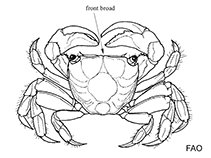
Malacostraca |
Decapoda |
Sesarmidae
Environnement : milieu / zone climatique / profondeur / gamme de distribution
Écologie
Benthic; saumâtre. Tropical
Western Indian Ocean: In the northwestern Indian Ocean from Arabian Gulf to the Gulf of Oman and Pakistan.
Longueur à la première maturité / Taille / Poids / Âge
Maturité: Lm ? range ? - ? cm Max length : 0.9 cm CL mâle / non sexé; (Réf. 107481); 0.824 cm CL (female)
It is found on rocky intertidal areas, rocky jetties, oyster banks and mangroves (Ref. 106819). Some under artificial stones or old boats at the intertidal (Ref. 115228). Found on sediments of varying sizes. Lives in small burrows among pneumatophores, under decaying wood and large dead shells (Ref. 107481).
Cycle de vie et comportement reproducteur
Maturité | Reproduction | Frai | Œufs | Fécondité | Larves
Naderloo, R. and M. Türkay 2012 Decapod crustaceans of the littoral and shallow sublittoral Iranian coast of the Persian Gulf: faunistics, biodiversity and zoogeography. Zootaxa 3374:1-67. (Réf. 106819)
Statut dans la liste rouge de l'IUCN
(Réf. 130435: Version 2025-2 (Global))
statut CITES (Réf. 108899)
Not Evaluated
Not Evaluated
Menace pour l'homme
Harmless
Utilisations par l'homme
FAO - Publication: search | FishSource |
Outils
Plus d'informations
Écologie trophiqueAliments (proies)
Composition du régime alimentaire
Consommation alimentaire
Prédateurs
Dynamique des populationsCroissance
Âges / tailles maximales
Longueur-poids rel.
Rel. longueur-longueur.
Fréquences de longueurs
Conversion de masse
Abondance
Cycle de vieReproductionMaturitéFéconditéFraiŒufsDéveloppement de l'œufLarves PhysiologieConsommation d'oxygène
Liées à l'hommeTimbres, pièces de monnaie, divers
Sources Internet
Estimations basées sur des modèles
Vulnérabilité de la pêche
(Réf. 71543) |
Low vulnerability (10 of 100). |