Gastropoda |
Neomphalida |
Peltospiridae
Environnement : milieu / zone climatique / profondeur / gamme de distribution
Écologie
Bathydémersal; profondeur 2415 - 2785 m (Réf. 127001). Subtropical
Western Indian Ocean. Mauritius (Ref 127040).
Longueur à la première maturité / Taille / Poids / Âge
Maturité: Lm ? range ? - ? cm
Description synthétique
Morphologie
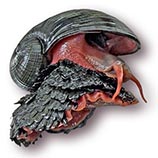
This species has a unique characteristics among gastropods, it carries hundreds of dermal sclerites on its foot. Sclerites: curved, elongate, proteinaceous, not calcified; ca. 1x 5 mm in size in adults; white to mettalic black depending on extent of iron sulphide coating; newly grown sclerites milky white. Ferrimagnetic when coated with iron sulphide layer. Shell: three whorls, globose with depressed spire, tighly coiled. Aperture elliptic, very large. Operculum: present in metapodium buried under layers of sclerites; multispiral, concentric in juveniles while curved, bent shape in adults.
Populations are found in hydrothermal vents several miles below the ocean surrounded with toxic chemicals and high temperatures reaching more than 300 deg C (Ref. 127038). Food is provided by bacteria that grow inside a special pouch in the snail's throat by converting the chemicals in the vents into energy (Ref. 127038). A deep-sea hydrothermal vent species, found on active black smokers as well as on diffuse flow sites (Ref. 127001).
Cycle de vie et comportement reproducteur
Maturité | Reproduction | Frai | Œufs | Fécondité | Larves
Chen, C., K. Linse, J.T. Copley and A.D. Rogers 2015 The 'scaly-foot gastropod': a new genus and species of hydrothermal vent-endemic gastropod (Neomphalina: Peltospiridae) from the Indian Ocean. Journal of Molluscan Studies 81:322-334. (Réf. 127001)
Statut dans la liste rouge de l'IUCN
(Réf. 130435: Version 2025-2 (Global))
Menacé (EN) (B2ab(iii)); Date assessed: 31 January 2018
statut CITES (Réf. 108899)
Not Evaluated
Not Evaluated
Menace pour l'homme
Harmless
Utilisations par l'homme
FAO - Publication: search | FishSource |
Outils
Plus d'informations
Écologie trophiqueAliments (proies)
Composition du régime alimentaire
Consommation alimentaire
Prédateurs
Dynamique des populationsCroissance
Âges / tailles maximales
Longueur-poids rel.
Rel. longueur-longueur.
Fréquences de longueurs
Conversion de masse
Abondance
Cycle de vieReproductionMaturitéFéconditéFraiŒufsDéveloppement de l'œufLarves PhysiologieConsommation d'oxygène
Liées à l'hommeTimbres, pièces de monnaie, divers
Sources Internet
Estimations basées sur des modèles
Vulnérabilité de la pêche
(Réf. 71543) |
(0 of 100). |