Malacostraca |
Decapoda |
Palaemonidae
Environnement : milieu / zone climatique / profondeur / gamme de distribution
Écologie
Récifal; profondeur 6 - 30 m (Réf. 83472). Tropical
Indo-Pacific.
Longueur à la première maturité / Taille / Poids / Âge
Maturité: Lm ? range ? - ? cm
Description synthétique
Morphologie
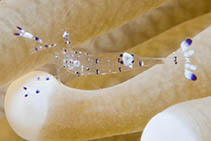
Body is almost transparent, with small brown or purple spots present at the posterior carapace and sometimes the abdomen. Body has a distinct V-shaped white and yellow patch on the third abdominal tergum. Legs and tail are white, with blue or purple near the joints and tips. Rostrum is usually arched and toothed.
In shallow waters, to depths reaching 30 meters. Mainly associated with sea anemones, but also observed on hard corals and jellyfish (Ref. 125532).
Cycle de vie et comportement reproducteur
Maturité | Reproduction | Frai | Œufs | Fécondité | Larves
Members of the order Decapoda are mostly gonochoric. Mating behavior: Precopulatory courtship ritual is common (through olfactory and tactile cues); usually indirect sperm transfer.
Li, X. and J.Y. Liu 2004 Report of Pontoniinae shrimps (Crustacea: Decapoda) collected by joint Chinese-German Marine Biology Expeditions to Hainan Island, South China Sea. III. Periclimenes. Chinese Journal of Oceanology and Limnology 22(1):89-100. (Réf. 81533)
Statut dans la liste rouge de l'IUCN
(Réf. 130435: Version 2025-2 (Global))
statut CITES (Réf. 108899)
Not Evaluated
Not Evaluated
Menace pour l'homme
Utilisations par l'homme
FAO - Publication: search | FishSource |
Outils
Plus d'informations
Écologie trophiqueAliments (proies)
Composition du régime alimentaire
Consommation alimentaire
Prédateurs
Dynamique des populationsCroissance
Âges / tailles maximales
Longueur-poids rel.
Rel. longueur-longueur.
Fréquences de longueurs
Conversion de masse
Abondance
Cycle de vieReproductionMaturitéFéconditéFraiŒufsDéveloppement de l'œufLarves PhysiologieConsommation d'oxygène
Liées à l'hommeTimbres, pièces de monnaie, divers
Sources Internet
Estimations basées sur des modèles