-

- About this page
- Languages
-
Feedback
- Citation
- Upload
-
Related species
- Eriphia sebana
- Species in
Eriphia - Species in
Eriphiidae - - Classification -
- Eriphiidae
- Decapoda
- Malacostraca
- Chordata
- Animalia
-



Eriphia smithii MacLeay, 1838
Rough redeyed crab
Upload your photos
Google image |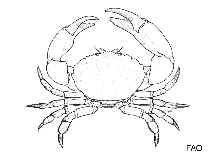 No image available for this species;
drawing shows typical species in Eriphiidae.
Google image |
drawing shows typical species in Eriphiidae.
Classification / Names Common names | Synonyms | CoL | ITIS | WoRMS
Malacostraca | Decapoda | Eriphiidae
Environment: milieu / climate zone / depth range / distribution range Ecology
Reef-associated; depth range 1 - ? m (Ref. 102564). Tropical
Distribution Countries | FAO areas | Ecosystems | Occurrences | Introductions
Indo-Pacific.
Length at first maturity / Size / Weight / Age
Maturity: Lm ? range ? - ? cm Max length : 6.0 cm CL male/unsexed; (Ref. 343)
Short description Morphology
Carapace rectangular, anterior surface granulated; anterolateral margins with numerous spines, but without distinct teeth or lobes. Base of movable finger of larger claw with large molariform tooth. Color: dark reddish brown overall, with bright red eyes.
Inhabits reefs. Subtropical and tropical climates (Ref. 343). Found on cliff holes and crevices. Active at both diurnal and nocturnal low tides, foraging from the rocky and soft substrates. Exhibits algal grazing during the day and predation, specifically at night, on crustaceans and mollusks (Ref. 76500). Largely an opportunistic feeder (Ref. 102732). Inhabits shallow waters, in reefs and rocky substrates. Takes shelter in crevices and holes (Ref. 9773).
Life cycle and mating behavior Maturity | Reproduction | Spawning | Eggs | Fecundity | Larvae
Members of the order Decapoda are mostly gonochoric. Mating behavior: Precopulatory courtship ritual is common (through olfactory and tactile cues); usually indirect sperm transfer.
Main reference
References | Coordinator | Collaborators
Ng, P.K.L. 1998 Crabs. p. 1045-1155. In K.E. Carpenter and V.H. Niem (eds) FAO species identification guide for fishery purposes. The living marine resources of the Western Central Pacific. Volume 2. Cephalopods, crustaceans, holothurians and sharks. Rome, FAO. 1998. pp. 687-1396. (Ref. 343)
IUCN Red List Status
(Ref. 130435: Version 2025-1)
CITES status (Ref. 108899)
Not Evaluated
CMS (Ref. 116361)
Not Evaluated
Threat to humans
Human uses
| FishSource |
Tools
More information
Trophic Ecology
Ecology
Population dynamics
Growth
Max. ages / sizes
Length-weight rel.
Length-length rel.
Length-frequencies
Mass conversion
Abundance
Max. ages / sizes
Length-weight rel.
Length-length rel.
Length-frequencies
Mass conversion
Abundance
Life cycle
Distribution
Physiology
Oxygen consumption
Human Related
Stamps, coins, misc.
Outreach
References
Internet sources
BHL | BOLD Systems | CISTI | DiscoverLife | FAO(Publication : search) | Fishipedia | GenBank (genome, nucleotide) | GloBI | Gomexsi | Google Books | Google Scholar | Google | PubMed | Tree of Life | Wikipedia (Go, Search) | Zoological Record
Estimates based on models
Price category
(Ref. 80766):
Unknown.