Malacostraca |
Decapoda |
Parapaguridae
Environnement : milieu / zone climatique / profondeur / gamme de distribution
Écologie
Benthic; profondeur 91 - 1995 m (Réf. 123237). Polar; 18°S - 57°S, 78°W - 180°E
Southern Hemisphere: from Peru, south to Chile then east to New Zealand.
Longueur à la première maturité / Taille / Poids / Âge
Maturité: Lm ? range ? - ? cm
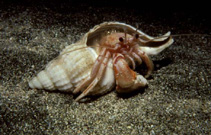
Common along the shelf. Inhabits gastropod shells, typically with actinian or zoanthid polyp attached to the shell, or in carcinoecia formed by colonies of Epizoanthus sp. Young individuals have been found in scaphopod shells (Ref. 123237).
Cycle de vie et comportement reproducteur
Maturité | Reproduction | Frai | Œufs | Fécondité | Larves
Members of the order Decapoda are mostly gonochoric. Mating behavior: Precopulatory courtship ritual is common (through olfactory and tactile cues); usually indirect sperm transfer.
McLaughlin, P. 2010 Sympagurus dimorphus. In McLaughlin, P. (2010) World Paguroidea database. Accessed through: World Register of Marine Species at http://www.marinespecies.org/aphia.php?p=taxdetails&id=246465 on 2011-07-26. (Réf. 87466)
Statut dans la liste rouge de l'IUCN
(Réf. 130435: Version 2025-2 (Global))
statut CITES (Réf. 108899)
Not Evaluated
Not Evaluated
Menace pour l'homme
Utilisations par l'homme
FAO - Publication: search | FishSource |
Outils
Plus d'informations
Écologie trophiqueAliments (proies)
Composition du régime alimentaire
Consommation alimentaire
Prédateurs
Dynamique des populationsCroissance
Âges / tailles maximales
Longueur-poids rel.
Rel. longueur-longueur.
Fréquences de longueurs
Conversion de masse
Abondance
Cycle de vieReproductionMaturitéFéconditéFraiŒufsDéveloppement de l'œufLarves PhysiologieConsommation d'oxygène
Liées à l'hommeTimbres, pièces de monnaie, divers
Sources Internet
Estimations basées sur des modèles
Vulnérabilité de la pêche
(Réf. 71543) |
(0 of 100). |
Catégorie de prix
(Réf. 80766): |
Unknown. |