Gastropoda |
Not assigned |
Lottiidae
สิ่งแวดล้อม : สิ่งแวดล้อม / เขตภูมิอากาศ / ระดับความลึก / ระยะการกระจายสินค้า
นิเวศวิทยา
Benthic. Subtropical
Pacific Ocean: Alaska to Mexico. Climate: boreal to tropical.
ความยาวเมื่อครบกำหนดครั้งแรก / ขนาด / น้ำหนัก / อายุ
วัยเจริญพันธุ์: Lm ? range ? - ? cm Max length : 3.5 cm SHL เพศผู้/กระเทย; (อ้างอิง 312); common length : 3.0 cm SHL เพศผู้/กระเทย; (อ้างอิง 312)
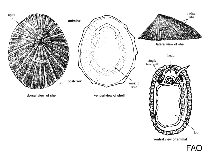
The peak near the front edge is far forward and may occasionally overhang the edge. The exterior varies in color but is usually brownish or olive green with a mix of large and fine dots. It is often pitted by a parasitic fungus and may have an eroded top (Ref. 312); Has a shell with an apex that is anterior. The anterior slope of the shell is concave and the posterior portion of the shell is convex. It has a strong ribbing on the posterior region. The shells are colored brownish green to greenish black and frequently appear eroded with white spots. The side of the foot is white (Ref. 310).
It has a shell length of 1.5 to 3.5 cm (Ref. 312). Habitat: Occurs in the high intertidal zone, on vertical and underside of rocks at low tide (Ref. 312); common in the high rocky intertidal zone and are typically found on vertical and overhanging rock faces and infrequently in tide pools; occasionally it is also found living on the goose-neck barnacle Pollicipes polymerus (Refs. 310, 95344). Inhabits deep cracks and crevices (Ref. 95344). Diet: microscopic films of algae; encrusting diatoms (Ref. 312). Behavior: Feeds at high tide when submerged. When exposed it becomes less active and attaches itself to the rock below usually with the anterior portion of their shell pointed down. It has the ability to secrete a mucus between its foot and shell that serves to secure on to the rock below and prevent desiccation and dislodgement. When exposed the heart and respiration rate also decreases. Respiration occurs through both a vascularized mantle fold and a single gill; in aggregate groups of 44 individuals. Predator: shorebirds and the crab Pachygraspsus crassipes (Ref. 312).
วงจรชีวิตและพฤติกรรมการผสมพันธุ์
วัยเจริญพันธุ์ | การสืบพันธุ์ | การวางไข่ | เซลสืบพันธ์ของเพศเมีย(ไข่) | ความดกของไข่ | ตัวอ่อน
Reproduction: Spawning occurs in the winter, spring and summer. Has a short veliger stage. Typically the planktonic (veliger) larvae only remain in the water column for a few days to around a month. Recruitment of new individuals occurs typically from November to January. This short planktonic stage only allows for a limited dispersal of new individuals and recruitment is typically from the same or adjacent shore (Ref. 310).
Gallivan, G. and J. Danforth 1999 Phylum Mollusca. Marine Science Institute. (อ้างอิง 312)
สถานะบัญชีแดงของ IUCN
(อ้างอิง 130435: Version 2025-2 (Global))
สถานะไซเตส (อ้างอิง 108899)
Not Evaluated
CMS (อ้างอิง 116361)
Not Evaluated
ภัยคุกคามต่อมนุษย์
การใช้ของมนุษย์
FAO - Publication: search | FishSource |
เครื่องมือ
ข้อมูลเพิ่มเติม
นิเวศวิทยาเขตร้อนรายการอาหาร (เหยื่อ)
องค์ประอบของอาหาร
การบริโภคอาหาร
ผู้ล่า
พลวัตของประชากรการเจริญเติบโต
อายุสูงสุด / ขนาด
ความยาว-น้ำหนักสัมพันธ์
ความยาว-ความยาวสัมพันธ์
ความยาว-ความถี่
การแปลงมวล
อุดมสมบรูณ์
วงจรชีวิตการสืบพันธุ์วัยเจริญพันธุ์ความดกของไข่การวางไข่เซลสืบพันธ์ของเพศเมีย(ไข่)การพัฒนาไข่ตัวอ่อน เกี่ยวข้องกับมนุษย์แสตมป์ เหรียญ อื่นๆ
แหล่งที่มาจากอินเตอร์เน็ต
การประมาณค่าตามแบบจำลอง
ความเสี่ยงต่อการตกปลา
(อ้างอิง 71543) |
Low vulnerability (10 of 100). |
หมวดหมู่ราคา
(อ้างอิง 80766): |
Unknown. |