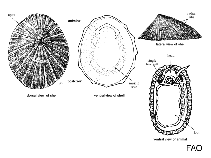
Gastropoda |
Not assigned |
Lottiidae
Environnement : milieu / zone climatique / profondeur / gamme de distribution
Écologie
Benthic. Temperate
Eastern Pacific: Canada.
Longueur à la première maturité / Taille / Poids / Âge
Maturité: Lm ? range ? - ? cm
Occurs in high intertidal zones. Grazing occurs at high tide on microscopic and macroscopic encrusting algae. Sessile when the tide is out. Preyed on by the sea star, Pisaster ochraceus; demonstrates an avoidance response to the presence of sea stars. Also preyed on by shore crabs, P. crassipes (Ref. 310).
Cycle de vie et comportement reproducteur
Maturité | Reproduction | Frai | Œufs | Fécondité | Larves
Reproduction: Occurs in winter; Spawning olive-green eggs occurs in January, February, April, and October. Recruitment occurs shortly thereafter (Ref. 310).
Anonymous 2001 Classification of Southern California Chitons. California State University Fullerton, Department of Biological Science. http://biology.fullerton.edu/biol317/Murray/Fall97/chitons.html [accessed 27/01/06] (Réf. 310)
Statut dans la liste rouge de l'IUCN
(Réf. 130435: Version 2025-2 (Global))
statut CITES (Réf. 108899)
Not Evaluated
Not Evaluated
Menace pour l'homme
Utilisations par l'homme
FAO - Publication: search | FishSource |
Outils
Plus d'informations
Dynamique des populationsCroissance
Âges / tailles maximales
Longueur-poids rel.
Rel. longueur-longueur.
Fréquences de longueurs
Conversion de masse
Abondance
Cycle de vieReproductionMaturitéFéconditéFraiŒufsDéveloppement de l'œufLarves PhysiologieConsommation d'oxygène
Liées à l'hommeTimbres, pièces de monnaie, divers
Sources Internet
Estimations basées sur des modèles
Vulnérabilité de la pêche
(Réf. 71543) |
(0 of 100). |
Catégorie de prix
(Réf. 80766): |
Unknown. |