Gastropoda |
Not assigned |
Lottiidae
Environnement : milieu / zone climatique / profondeur / gamme de distribution
Écologie
Benthic. Temperate
Northeast Pacific: USA.
Longueur à la première maturité / Taille / Poids / Âge
Maturité: Lm ? range ? - ? cmCommon length : 2.2 cm SHL mâle / non sexé; (Réf. 310)
Description synthétique
Morphologie
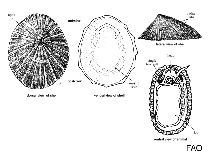
Is has a shell with an apex that anterior. The profile of the shell is low and is recognized as having low radial ribs. Some individuals have an eroded appearance. Often the posterior is pitted by the fungus Didymella conchae. The color of the exterior of the shell is typically dull grey in appearance. The interior of the shell is white to blue with a dark border. The side of the foot is white. (Ref. 310).
It has a shell length of 1.5 to 2.2 cm (Ref. 310). Diet: microscopic algae and diatoms. Behavior: It is active when submerged. When exposed it attaches itself to the substratum by secreting a mucus sheet between its foot and shell that prevents desiccation and dislodgement. When submerged the gill expands and respiration and heart rates increase (Ref. 310).
Cycle de vie et comportement reproducteur
Maturité | Reproduction | Frai | Œufs | Fécondité | Larves
Reproduction: Occurs in winter (Ref. 310).
Anonymous 2001 Classification of Southern California Chitons. California State University Fullerton, Department of Biological Science. http://biology.fullerton.edu/biol317/Murray/Fall97/chitons.html [accessed 27/01/06] (Réf. 310)
Statut dans la liste rouge de l'IUCN
(Réf. 130435: Version 2025-2 (Global))
statut CITES (Réf. 108899)
Not Evaluated
Not Evaluated
Menace pour l'homme
Utilisations par l'homme
FAO - Publication: search | FishSource |
Outils
Plus d'informations
Écologie trophiqueAliments (proies)
Composition du régime alimentaire
Consommation alimentaire
Prédateurs
Dynamique des populationsCroissance
Âges / tailles maximales
Longueur-poids rel.
Rel. longueur-longueur.
Fréquences de longueurs
Conversion de masse
Abondance
Cycle de vieReproductionMaturitéFéconditéFraiŒufsDéveloppement de l'œufLarves PhysiologieConsommation d'oxygène
Liées à l'hommeTimbres, pièces de monnaie, divers
Sources Internet
Estimations basées sur des modèles
Vulnérabilité de la pêche
(Réf. 71543) |
(0 of 100). |
Catégorie de prix
(Réf. 80766): |
Unknown. |