Malacostraca |
Decapoda |
Portunidae
Milieu: milieu / Klimaatzone / Diepte / verspreidingsgebied
Ecologie
Benthopelagisch; diepte 0 - 50 m (Ref. 125642). Tropical
Western Pacific: from Japan to Malaysia. Subtropical and tropical climates.
Lengte bij maturiteit / Grootte / Gewicht / Leeftijd
Maturiteit: Lm ? range ? - ? cm Max length : 7.0 cm CW mannelijk / geslacht onbekend; (Ref. 343)
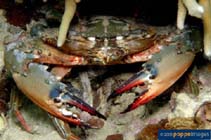
Carapace without transverse ridges behind last anterolateral tooth; frontal teeth acutely triangular; anterolateral all acutely triangular. Posterior border of propodus of legs serrated. Palm with 5sharp spines, longitudinal ridges on palm granulated. Color: carapace white with large greyish patches, tips at anterolateral teeth reddish brown; fingers red and white.
Subtropical and tropical climates (Ref. 343). Found intertidal to subtidal, on substrates ranging from seagrass, mud, sand, to rocks. Occur to depths of 50 meters (Ref. 125642). Also found in tidepools on rocky shores (Ref. 118296). Common in estuaries, in firm or muddy fine sands (Ref. 118295). Generalist scavenger and predator (Ref. 118296). Benthopelagic predator, feeding mainly on benthic bivalves (Lamellibranchia), benthic crustaceans, fishes, and cephalopods (Ref. 117071). Host to the sacculinid barnacle Heterosaccus papillosus (Ref. 118296).
Levenscyclus en paargedrag
Maturiteit | Voortplanting | Paaien | Eieren | Fecunditeit | Larven
Members of the order Decapoda are mostly gonochoric. Mating behavior: Precopulatory courtship ritual is common (through olfactory and tactile cues); usually indirect sperm transfer.
Ng, P.K.L. 1998 Crabs. p. 1045-1155. In K.E. Carpenter and V.H. Niem (eds) FAO species identification guide for fishery purposes. The living marine resources of the Western Central Pacific. Volume 2. Cephalopods, crustaceans, holothurians and sharks. Rome, FAO. 1998. pp. 687-1396. (Ref. 343)
Status op de Rode Lijst van het IUCN
(Ref. 130435: Version 2025-2 (Global))
CITES status (Ref. 108899)
Not Evaluated
Not Evaluated
Gevaar voor de mens
Gebruik door de mens
FAO - Publication: search | FishSource |
Tools
Meer informatie
LevenscyclusVoortplantingMaturiteitFecunditeitPaaienEierenOntwikkeling van de eierenLarven FysiologieZuurstofverbruik
Menselijk gerelateerdPostzegels, munten, diversen.
Internetbronnen
Schattingen op basis van modellen
Kwetsbaarheid van de visserij
(Ref. 71543) |
Low vulnerability (10 of 100). |
Prijsklasse
(Ref. 80766): |
Unknown. |