Malacostraca |
Decapoda |
Xanthidae
Environnement : milieu / zone climatique / profondeur / gamme de distribution
Écologie
Récifal; profondeur 0 - 10 m (Réf. 96667). Tropical
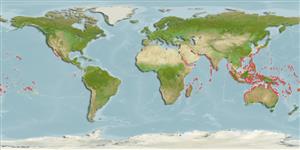
Indo-Pacific: from East Africa to French Polynesia.
Longueur à la première maturité / Taille / Poids / Âge
Maturité: Lm ? range ? - ? cm Max length : 10.0 cm CL mâle / non sexé; (Réf. 128968)
Description synthétique
Morphologie
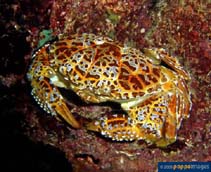
The carapace has protruding frontal borders which are divided into four lobes (first three are rounded and the fourth is tooth-like. The body is covered with eye-like chocolate brown spots and smooth, well-defined lobules. Both front pincers are of the same size, while the walking legs are fringed with long hairs (Ref. 128968).
Adults occur in coral reefs, hidden under rocks during the day. Nocturnal (Ref. 128968). The shell and flesh of this species contain neosaxitoxin, saxitoxin, and tetrodotoxin (Ref. 107779, 128965) which have been proven to be fatal when ingested (Ref. 128965). Intertidal to subtidal (Ref. 106854). Members of the family Xanthidae range from being algal scrapers to aggressive predators (Ref. 103027).
Cycle de vie et comportement reproducteur
Maturité | Reproduction | Frai | Œufs | Fécondité | Larves
Members of the order Decapoda are mostly gonochoric. Mating behavior: Precopulatory courtship ritual is common (through olfactory and tactile cues); usually indirect sperm transfer.
MarineSpecies.org 2050 MarineSpecies.org. http://www.marinespecies.org/index.php (Réf. 3477)
Statut dans la liste rouge de l'IUCN
(Réf. 130435: Version 2025-2 (Global))
statut CITES (Réf. 108899)
Not Evaluated
Not Evaluated
Menace pour l'homme
Poisonous to eat (Réf. 107779)
Utilisations par l'homme
Pêcheries: commercial
FAO - Publication: search | FishSource | Sea Around Us
Outils
Plus d'informations
Écologie trophiqueAliments (proies)
Composition du régime alimentaire
Consommation alimentaire
Prédateurs
Dynamique des populationsCroissance
Âges / tailles maximales
Longueur-poids rel.
Rel. longueur-longueur.
Fréquences de longueurs
Conversion de masse
Abondance
Cycle de vieReproductionMaturitéFéconditéFraiŒufsDéveloppement de l'œufLarves PhysiologieConsommation d'oxygène
Liées à l'hommeTimbres, pièces de monnaie, divers
Sources Internet
Estimations basées sur des modèles
Vulnérabilité de la pêche
(Réf. 71543) |
Low vulnerability (10 of 100). |
Catégorie de prix
(Réf. 80766): |
Unknown. |
Nutrients
|
Calcium = 109 [35, 184] mg/100g; Iron = 1.59 [1.21, 1.97] mg/100g; Protein = 20.2 [19.2, 21.3] %; Omega3 = 0.285 [0.185, 0.386] g/100g; Selenium = 48.3 [-31.7, 128.3] μg/100g; VitaminA = 0 μg/100g; Zinc = 1.79 [1.17, 2.40] mg/100g (wet weight); based on nutrient studies. |