Malacostraca |
Mysida |
Mysidae
Environnement : milieu / zone climatique / profondeur / gamme de distribution
Écologie
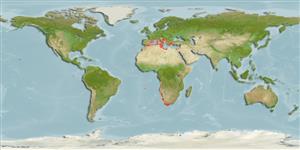
Benthic; profondeur 60 - 400 m (Réf. 85342). Subtropical
Eastern Atlantic and the Mediterranean Sea: France, Italy and South Africa. Subtropical to temperate.
Longueur à la première maturité / Taille / Poids / Âge
Maturité: Lm ? range ? - ? cm
This species is found in marine, fresh and brackish waters particularly at littoral zones with sandy bottoms. They are known to be adaptive to varying degrees of salinity and display diurnal vertical migrations (Ref. 85342).
Cycle de vie et comportement reproducteur
Maturité | Reproduction | Frai | Œufs | Fécondité | Larves
Members of the order Mysida are gonochoric. Mating behavior: Male inserts the penis into the marsupium and releases sperm; eggs are then released from the oviducts into the marsupium where fertilization occurs. Life cycle: Eggs are brooded in the marsupium and later hatch into miniature adults, no postlarva.
San Vicente, C. 2010 Checklist of the orders Mysida and Lophogastrida (Phylum Arthropoda) known in the different Mediterranean regions considered. pp. 247-275 In Coll, M., et al., 2010. The biodiversity of the Mediterranean Sea: estimates, patterns, and threats. PLoS ONE 5(8):36pp. (Réf. 85342)
Statut dans la liste rouge de l'IUCN
(Réf. 130435: Version 2025-2 (Global))
statut CITES (Réf. 108899)
Not Evaluated
Not Evaluated
Menace pour l'homme
Utilisations par l'homme
FAO - Publication: search | FishSource |
Outils
Plus d'informations
Écologie trophiqueAliments (proies)
Composition du régime alimentaire
Consommation alimentaire
Prédateurs
Dynamique des populationsCroissance
Âges / tailles maximales
Longueur-poids rel.
Rel. longueur-longueur.
Fréquences de longueurs
Conversion de masse
Abondance
Cycle de vieReproductionMaturitéFéconditéFraiŒufsDéveloppement de l'œufLarves PhysiologieConsommation d'oxygène
Liées à l'hommeTimbres, pièces de monnaie, divers
Sources Internet
Estimations basées sur des modèles
Vulnérabilité de la pêche
(Réf. 71543) |
(0 of 100). |
Catégorie de prix
(Réf. 80766): |
Unknown. |