Malacostraca |
Amphipoda |
Melitidae
पर्यावरण: पर्यावरण / जलवायु क्षेत्र / गहराई सीमा / वितरण सीमा
पारिस्थितिकी
Benthic; गहराई सीमा 0 - 60 m (संदर्भ 108754). Tropical
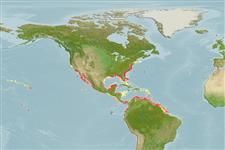
Western Central Atlantic: USA.
प्रथम परिपक्वता पर लंबाई / आकार / वज़न / आयु
परिपक्व अवधि: Lm ? range ? - ? cm
Prefers very shallow water along the shoreline where leaves and other mangrove debris accumulate (Ref. 108780). Found in an estuary (Ref. 108782). On salt marsh, hard substrate, and seagrass (Ref. 110266). Occurs under decaying mangroves during daytime. Grazes on the bacteria-laden organic scum off the undersides of mangrove leaves. Other gut contents include fine inorganic matter, vascular plant detritus, along with bacteria and protozoa. Nocturnal grazing also occurs, consuming microalgae on the exposed upper surfaces of decaying leaves. Observed to tear apart large pieces of decaying leaves (Ref. 108780).
जीवन चक्र और संभोग व्यवहार
परिपक्व अवधि | पुनरुत्पत्ति | मछलीऔ का अंडे देना | अंडे | उपजाऊपन | लार्वा
Members of the order Amphipoda are gonochoric and sexually dimoprhic (males larger than females). Mating behavior: Males locate potential partners with the aid of their antenna to detect the pheromones released by the females; the male then rides or carries the female until the latter is ready to molt. When the female is ready, the male pushes the sperm into the marsupium and releases the female afterwards. A few hours later, the female releases her eggs into the marsupium for fertilization. Life cycle: Eggs are brooded in the marsupium. Eggs hatch into juveniles and remain in the marsupium for a few days. Each species undergo 20 molts at most, i.e., 1-year long life cycle.
Vittor, B.A. 2002 Gray's Reef benthic macroinvertebrate community assessment, April 2001. Final Report to NOAA under contract No. 50-DGNC-0-90024, NOAA NOS, Charleston, SC. (संदर्भ 3209)
आईयूसीएन रेड लिस्ट स्थिति
(संदर्भ 130435: Version 2025-2 (Global))
CITES स्थिति (संदर्भ 108899)
Not Evaluated
CMS (संदर्भ 116361)
Not Evaluated
मनुष्यों के लिए ख़तरा
मानव उपयोग
FAO - Publication: search | FishSource |
साधन
अधिक जानकारी
जनसंख्या गतिशीलताबाढ़
अधिकतम आयु/आकार
लंबाई-वजन संबंध
लंबाई-लंबाई संबंध
लंबाई-आवृत्तियाँ
सामूहिक रूपांतरण
बहुतायत
जीवन चक्रपुनरुत्पत्तिपरिपक्व अवधिउपजाऊपनमछलीऔ का अंडे देनाअंडेअंडे का विकासलार्वा फिजियोलॉजीप्राणवायु की खपत
मानव संबंधीटिकट, सिक्के, विविध.
इंटरनेट स्रोत
मॉडल पर आधारित अनुमान
मछली पकड़ने की भेद्यता
(संदर्भ 71543) |
(0 of 100). |
मूल्य श्रेणी
(संदर्भ 80766): |
Unknown. |