Malacostraca |
Amphipoda |
Ampeliscidae
Umwelt: Milieu / Klimazone / Tiefenbereich / Verbreitungsgebiet
Ökologie
Benthopelagisch; tiefenbereich 92 - 835 m (Ref. 78173). Polar
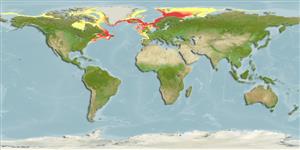
Arctic; Northern Atlantic: Scandinavia to Britain and Nova Scotia to mid-Atlantic States.
Länge bei der ersten Reifung / Größe / Gewicht / Alter
Geschlechtsreife: Lm ? range ? - ? cm
Found on continental shelf and slope. Feeding type is via deposit or suspension feeding (Ref. 87872).
Lebenszyklus und Paarungsverhalten
Geschlechtsreife | Fortpflanzung | Ablaichen | Eier | Fruchtbarkeit | Larven
Members of the order Amphipoda are gonochoric and sexually dimoprhic (males larger than females). Mating behavior: Males locate potential partners with the aid of their antenna to detect the pheromones released by the females; the male then rides or carries the female until the latter is ready to molt. When the female is ready, the male pushes the sperm into the marsupium and releases the female afterwards. A few hours later, the female releases her eggs into the marsupium for fertilization. Life cycle: Eggs are brooded in the marsupium. Eggs hatch into juveniles and remain in the marsupium for a few days. Each species undergo 20 molts at most, i.e., 1-year long life cycle.
Cusson, M., P. Archambault and A. Aitken 2007 Biodiversity of benthic assemblages on the Arctic continental shelf: historical data form Canada. Mar. Ecol. Prog. Ser. 331:291-304. (Ref. 3448)
IUCN Rote Liste Status
(Ref. 130435: Version 2025-2 (Global))
CITES Status (Ref. 108899)
Not Evaluated
Not Evaluated
Bedrohung für Menschen
Nutzung durch Menschen
FAO - Publication: search | FishSource |
Tools
Mehr Information
Trophische ÖkologieLebensmittel (Beutetiere)
Nahrungszusammensetzung
Nahrungsaufnahme
Räuber
PopulationsdynamikWachstum
Max. Alter/Größen
Länge-Gewicht-Rel.
Länge-Länge-Verhältnis.
Längenhäufigkeiten
Massenkonvertierung
Dichte
LebenszyklusFortpflanzungGeschlechtsreifeFruchtbarkeitAblaichenEierEientwicklungLarven PhysiologieSauerstoffverbrauch
MenschenbezogenBriefmarken, Münzen, Verschiedenes.
Internet Quellen
Schätzungen auf der Grundlage von Modellen
Anfälligkeit der Fischerei
(Ref. 71543) |
(0 of 100). |
Preiskategorie
(Ref. 80766): |
Unknown. |