-

- About this page
- Languages
-
Feedback
- Citation
- Upload
-
Related species
- Species in
Macrobrachium - Species in
Palaemonidae - - Classification -
- Palaemonidae
- Decapoda
- Malacostraca
- Chordata
- Animalia
- Species in
-



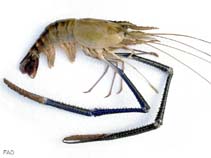
Macrobrachium rosenbergii (De Man, 1879)
Giant river prawn| Native range | All suitable habitat | Point map | Year 2050 |

|
| This map was computer-generated and has not yet been reviewed. |
| Macrobrachium rosenbergii AquaMaps Data sources: GBIF OBIS |
Classification / Names Common names | Synonyms | CoL | ITIS | WoRMS
Malacostraca | Decapoda | Palaemonidae
Environment: milieu / climate zone / depth range / distribution range Ecology
Benthic; freshwater; brackish; depth range 0 - 2 m (Ref. 97531). Tropical; 21°N - 18°S, 116°E - 151°E (Ref. 110598)
Distribution Countries | FAO areas | Ecosystems | Occurrences | Introductions
Indo-Pacific: M. rosenbergii actually are two separate species; M. rosenbergii is distributed East of Huxley's Line from the Philippines (including Palawan), Lesser Sunda Islands, New Guinea and northern Australia and M. dacqueti ranges from Pakistan, India, Sri Lanka to the Asian mainland in southern China, Taiwan and up to Malaysia, Borneo and Java.
Length at first maturity / Size / Weight / Age
Maturity: Lm ? range ? - ? cm Max length : 34.0 cm TL male/unsexed; (Ref. 104052); 26 cm TL (female)
Wild post larvae migrate to down-stream near to the sea to a higher elevation freshwater waters streams (Ref. 82055). The native range of Macrobrachium rosenbergii actually consists of two separate species differing in adult morphological features. The actual M. rosenbergii occurs in northern Australia, Papua New Guinea, eastern Indonesia (east of Huxley's line including Bali) and the Philippines (includes Palawan). The second species is discovered as M. dacqueti (Sunier, 1925) which is actually the species extensively commercially fished and cultured. This species occurs in Asian mainland from Pakistan, India, Sri Lanka and southern China and to the western border of Huxley's line excluding Palawan, up to Borneo and Java (Ref. 110598, 110593). Coastal freshwater and estuarine (Ref. 97531), found in a mangrove (Ref. 121467). Survival rate and growth high at 0-15 ppt (Ref. 111574).
Life cycle and mating behavior Maturity | Reproduction | Spawning | Eggs | Fecundity | Larvae
Members of the order Decapoda are mostly gonochoric. Mating behavior: Precopulatory courtship ritual is common (through olfactory and tactile cues); usually indirect sperm transfer.
Main reference
References | Coordinator | Collaborators
del Mundo, C.M. 2000 Philippine decapod crustacea. An illustrated handbook on the commercially important decapod crustacea of the Philippines. Fisheries Resources Evaluation and Environmental Services Division, Bureau of Fisheries and Aquatic Resources. Quezon City, Philippines. 83 p. (Ref. 10)
IUCN Red List Status
(Ref. 130435: Version 2025-1)
CITES status (Ref. 108899)
Not Evaluated
CMS (Ref. 116361)
Not Evaluated
Threat to humans
Human uses
Fisheries: commercial
FAO - Aquaculture: production, species profile; Fisheries: landings, species profile | FishSource | Sea Around Us
Tools
More information
Trophic Ecology
Food items (preys)
Diet composition
Food consumption
Predators
Diet composition
Food consumption
Predators
Ecology
Population dynamics
Growth
Max. ages / sizes
Length-weight rel.
Length-length rel.
Length-frequencies
Mass conversion
Abundance
Max. ages / sizes
Length-weight rel.
Length-length rel.
Length-frequencies
Mass conversion
Abundance
Life cycle
Distribution
Physiology
Oxygen consumption
Human Related
Stamps, coins, misc.
Outreach
Taxonomy
References
Internet sources
BHL | BOLD Systems | CISTI | DiscoverLife | FAO(Aquaculture: species profile; Fisheries: species profile; publication : search) | Fishipedia | GenBank (genome, nucleotide) | GloBI | Gomexsi | Google Books | Google Scholar | Google | PubMed | Tree of Life | Wikipedia (Go, Search) | Zoological Record
Estimates based on models
Preferred temperature
(Ref. 115969): 26.7 - 29.3, mean 28.7 (based on 1400 cells).