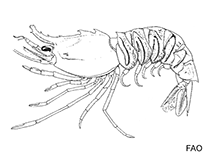
Malacostraca |
Decapoda |
Sicyoniidae
Environnement : milieu / zone climatique / profondeur / gamme de distribution
Écologie
Benthic; profondeur 1 - 330 m (Réf. 8), usually 10 - 110 m (Réf. 112661). Tropical, preferred 25°C (Réf. 107945); 39°N - 14°N, 106°W - 70°W
Eastern Pacific and Western Atlantic: In the eastern Pacific from Colima to Chiapas, Mexico, and in the western Atlantic from Norfolk Virginia, along USA and Bahamas to the southern coast of Cuba, Gulf of Mexico from Florida Keys to Yucatan.
Longueur à la première maturité / Taille / Poids / Âge
Maturité: Lm ? range ? - ? cm Max length : 15.3 cm TL mâle / non sexé; (Réf. 8)
Minimum depth from Ref. 356. Prefers bottom white and shelly sand (Ref. 8). Generalized carnivore, feeds at night, mainly on mollusks and crustaceans (Ref. 111994).
Cycle de vie et comportement reproducteur
Maturité | Reproduction | Frai | Œufs | Fécondité | Larves
Members of the order Decapoda are mostly gonochoric. Mating behavior: Precopulatory courtship ritual is common (through olfactory and tactile cues); usually indirect sperm transfer.
Holthuis, L.B. 1980 FAO Species Catalogue. Vol. 1. Shrimps and prawns of the world. An annotated catalogue of species of interest to fisheries. FAO Fish. Synop. 125(1):271 p. Rome: FAO. (Réf. 8)
Statut dans la liste rouge de l'IUCN
(Réf. 130435: Version 2025-2 (Global))
statut CITES (Réf. 108899)
Not Evaluated
Not Evaluated
Menace pour l'homme
Utilisations par l'homme
Pêcheries: commercial
FAO - pêcheries: Résumé espèce, landings search; Publication: search | FishSource | Sea Around Us
Outils
Plus d'informations
Dynamique des populationsCroissanceÂges / tailles maximalesLongueur-poids rel.Rel. longueur-longueur.Fréquences de longueursConversion de masseAbondance Cycle de vieReproductionMaturitéFéconditéFraiŒufsDéveloppement de l'œufLarves PhysiologieConsommation d'oxygène
Liées à l'hommeTimbres, pièces de monnaie, divers
Sources Internet
Estimations basées sur des modèles
Rate of population increase
|
Prior r = 0.81, 95% CL = 0.54 - 1.22, Based on 1 data-limited stock assessment. |
Vulnérabilité de la pêche
(Réf. 71543) |
Low vulnerability (10 of 100). |
Vulnérabilité climatique
(Réf. 125649) |
Moderate to high vulnerability (48 of 100) |
Catégorie de prix
(Réf. 80766): |
Very high. |
Nutrients
|
Calcium = 109 [35, 184] mg/100g; Iron = 1.59 [1.21, 1.97] mg/100g; Protein = 20.2 [19.2, 21.3] %; Omega3 = 0.285 [0.185, 0.386] g/100g; Selenium = 48.3 [-31.7, 128.3] μg/100g; VitaminA = 0 μg/100g; Zinc = 1.79 [1.17, 2.40] mg/100g (wet weight); based on nutrient studies. |