Malacostraca |
Decapoda |
Menippidae
Environnement : milieu / zone climatique / profondeur / gamme de distribution
Écologie
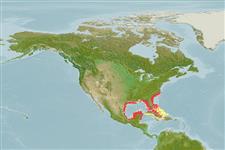
Benthic; profondeur 0 - 60 m (Réf. 114309). Tropical, preferred 25°C (Réf. 107945); 35°N - 18°N, 98°W - 71°W
Western Central Atlantic: from Mexico to Turks and Caicos, then Cape Lookout North Carolina south to Jamaica.
Longueur à la première maturité / Taille / Poids / Âge
Maturité: Lm 6.6 range ? - ? cm
Description synthétique
Morphologie
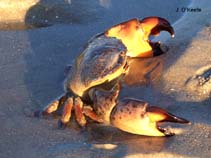
Carapace transversely oval, about 2.3 times as long as wide, convex, nearly smooth to unaided eye, minutely granulate and punctate; anterolateral margins (excluding outer orbital teeth) divided into 4 lobes, front (excluding inner orbital angles) with a median notch and a broad tri-lobate lobe on each side. Pincers large and heavy, unequal, nearly smooth; inside of hands with patch of fine, oblique, parallel striae; walking legs stout and hairy distally. Color: juveniles dark purplish blue, very young with legs banded cream and red and white spot on carpus of pincer. Older individual become dark brownish red to black or less mottled and spotted with dusky grey; fingers dark; walking legs with reddish and yellow bands.
Occurs at depths down to 60 m (Ref. 114309). Burrows in mudflats just below low-tide mark, among rocks on jetties, on offshore reef areas, under rocks or coral heads and among dead shells or grass clumps (Ref. 367), burrows in seagrass beds, oyster reefs and crevices in rocks (Ref. 114309). Occasionally burrow in colonies. Tolerant to salinities considerably lower or higher than 35. Somewhat active both day and night, greatest activity observed during the evening before dark. Preys on oysters and other mollusks (Ref. 367).
Cycle de vie et comportement reproducteur
Maturité | Reproduction | Frai | Œufs | Fécondité | Larves
Ovigerous females are known from May to September.
Tavares, M. 2003 True Crabs. pp. 327-352. In Carpenter, K.E. (ed.) The living marine resources of the Western Central Atlantic. Volume1: introdution, molluscs, crustaceans, hagfishes, sharks, batoid fishes, and chimaeras. FAO Species Identification Guide for Fishery Purposes and American Society of Ichthyologists and Herpetologists Special PublicationNo. 5. Rome, FAO. pp. 1-600. (Réf. 367)
Statut dans la liste rouge de l'IUCN
(Réf. 130435: Version 2025-2 (Global))
statut CITES (Réf. 108899)
Not Evaluated
Not Evaluated
Menace pour l'homme
Utilisations par l'homme
Pêcheries: commercial
FAO - pêcheries: landings search; Publication: search | FishSource | Sea Around Us
Outils
Plus d'informations
Dynamique des populations PhysiologieConsommation d'oxygène
Liées à l'hommeTimbres, pièces de monnaie, divers
Sources Internet
Estimations basées sur des modèles
Vulnérabilité de la pêche
(Réf. 71543) |
(0 of 100). |
Vulnérabilité climatique
(Réf. 125649) |
High to very high vulnerability (67 of 100) |
Catégorie de prix
(Réf. 80766): |
Very high. |
Nutrients
|
Calcium = 109 [35, 184] mg/100g; Iron = 1.59 [1.21, 1.97] mg/100g; Protein = 20.2 [19.2, 21.3] %; Omega3 = 0.285 [0.185, 0.386] g/100g; Selenium = 48.3 [-31.7, 128.3] μg/100g; VitaminA = 0 μg/100g; Zinc = 1.79 [1.17, 2.40] mg/100g (wet weight); based on nutrient studies. |