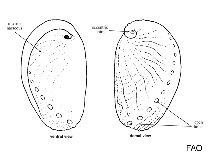
Gastropoda |
Lepetellida |
Haliotidae
Milieu: milieu / Klimaatzone / Diepte / verspreidingsgebied
Ecologie
Benthic; diepte 20 - 66 m (Ref. 101453), usually 43 - 60 m (Ref. 101453). Subtropical; 34°N - 26°N, 121°W - 112°W
Eastern Pacific: USA to Mexico. From Point Conception, California to Punta Abreojos in Baja California.
Lengte bij maturiteit / Grootte / Gewicht / Leeftijd
Maturiteit: Lm ?, range 9 - 13.4 cm Max length : 25.0 cm TL mannelijk / geslacht onbekend; (Ref. 865); max. gerapporteerde leeftijd: 40 Jaren (Ref. 105226)
Historically, found at depths between 25 and 30 m and reported to be formerly common in depths of 10 to 20 m (Ref. 101453). Minimum depth from Ref. 106850. Sedentary (Ref. 106850). Found in open low relief rock or boulder habitat surrounded by sand, often at the sand-rock interface (Ref. 101461). Also occurs in open, exposed deep-water reefs with kelp understory (Ref. 106850). Feeds on drift macroalgae and attached red algae (Ref. 101622).
Broadcast spawners. Life cycle: Embryos develop into planktonic trocophore larvae and later into juvenile veligers before becoming fully grown adults (Ref. 833). Also Refs. 105220, 105232.
Bisby, F.A., M.A. Ruggiero, K.L. Wilson, M. Cachuela-Palacio, S.W. Kimani, Y.R. Roskov, A. Soulier-Perkins and J. van Hertum 2005 Species 2000 & ITIS Catalogue of Life: 2005 Annual Checklist. CD-ROM; Species 2000: Reading, U.K. (Ref. 19)
Status op de Rode Lijst van het IUCN
(Ref. 130435: Version 2025-2 (Global))
CITES status (Ref. 108899)
Not Evaluated
Not Evaluated
Gevaar voor de mens
Gebruik door de mens
Visserij: commercieel
FAO - Publication: search | FishSource |
Tools
Meer informatie
FysiologieZuurstofverbruik
Menselijk gerelateerdPostzegels, munten, diversen.
Internetbronnen
Schattingen op basis van modellen
Kwetsbaarheid van de visserij
(Ref. 71543) |
High vulnerability (56 of 100). |
Prijsklasse
(Ref. 80766): |
Very high. |