Malacostraca |
Decapoda |
Pandalidae
Environnement : milieu / zone climatique / profondeur / gamme de distribution
Écologie
Benthic; profondeur 18 - 177 m (Réf. 93876). Boreal
Northeast Pacific and Northwest Atlantic: Alaska, Canada and USA.
Longueur à la première maturité / Taille / Poids / Âge
Maturité: Lm ? range ? - ? cm
Description synthétique
Morphologie
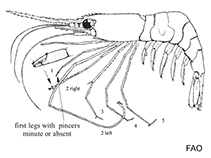
Ordinarily known as "coon-stripe" because of the peculiar striping of red or brown and white which is especially evident in the younger individuals. It is a rather stout species with a finely pitted surface and 10 to 12 median dorsal spines, all movable, about half of them on the carapace. The rostrum is a little longer than the carapace, the terminal half is unarmed above,
the apex trifid, the lower margin 6 to 8 spined.
Cycle de vie et comportement reproducteur
Maturité | Reproduction | Frai | Œufs | Fécondité | Larves
Metamorphosis finishes by late June, growth was rapid until October where males became sexually mature. They remain as males by the second autumn, sex change occurs in the third spring. Spawning starts in October, egg hatches by March and April (Ref. 82562).
Williams, A.B., L.G. Abele, D.L. Felder, H.H. Hobbs Jr., R.B. Manning, P.A. McLaughlin and I. Pérez Farfante 1988 Common and scientific names of aquatic invertebrates from the United States and Canada: decapod crustaceans. American Fisheries Society Special Publication 17. 77 pp. + 12 figs. (Réf. 2214)
Statut dans la liste rouge de l'IUCN
(Réf. 130435: Version 2025-2 (Global))
statut CITES (Réf. 108899)
Not Evaluated
Not Evaluated
Menace pour l'homme
Utilisations par l'homme
Pêcheries: commercial
FAO - Publication: search | FishSource |
Outils
Plus d'informations
Écologie trophiqueAliments (proies)Composition du régime alimentaireConsommation alimentairePrédateurs Dynamique des populations PhysiologieConsommation d'oxygène
Liées à l'hommeTimbres, pièces de monnaie, divers
Sources Internet
Estimations basées sur des modèles