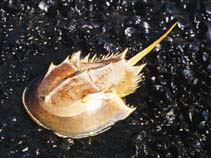
Limulus polyphemus, Horseshoe crab : fisheries
Advertisement

You can sponsor this page

Limulus polyphemus   (Linnaeus, 1758)

Horseshoe crab

Native range | All suitable habitat | Point map | Year 2050
This map was computer-generated and has not yet been reviewed.
Limulus polyphemus  AquaMaps  Data sources: GBIF OBIS
上傳你的 相片 
所有照片 | Google 影像 |
Image of Limulus polyphemus (Horseshoe crab)
Limulus polyphemus
Picture by Harvey-Clark, Chris

分類 / 名稱 俗名 | 同種異名 | CoL | ITIS | WoRMS

Merostomata | Xiphosura | Limulidae

環境: 環境 / 氣候帶 / 深度上下限 / 配送範圍 生態學

Benthic; 深度上下限 3 - 290 m (參考文獻 137822).  Tropical, preferred 24°C (參考文獻 107945); 44°N - 18°N, 93°W - 66°W

分布 Territories | FAO區域 | 生態系 | 發現紀錄 | 簡介

Western Atlantic: Known from the Gulf of Maine to Florida, USA and along the coast of the Gulf of Mexico from Florida to the Yucatan Peninsula, but absent from the western and southern Gulf of Mexico (from Texas, USA to Tabasco, Mexico). Introduced in Northeast Atlantic.

初熟時的長度 / 大小 / 重量 / 年齡

成熟度: Lm ?  range ? - ? cm Max length : 60.0 cm TL 雄魚/尚未辨別雌雄; (參考文獻 82); 最大體重: 1.8 kg (參考文獻 82); 最大年齡: 20 年 (參考文獻 99652)

生物學特性     字彙 (例如 附生動物)

The males are approximately 1/3 the size of the females (sexual dimorphism) (Ref. 83). Minimum depth based from Ref. 76. Lives in shallow waters, with sandy or muddy bottoms (Ref. 76). Found in intertidal and offshore areas (Ref. 1131). The horseshoe crab feeds at night on polychaete worms such as Cerebratulus, Nereis, and Cistenides (Ref. 76, 77), small mollusks, and seaweed (algae) found in the sandy ocean bottom (Ref. 76). Food is picked up by the chelicerae and passed back to the bristle bases, where it is "chewed." The food is then moved forward to the mouth (Ref. 75). It digs its food from sediments, grasping the prey with its legs. The prey is moved to the gnathobases where it is crushed before being pushed forward toward the mouth (Ref. 77). A life span of about 20 to 40 years (Ref. 78). Its predators are loggerhead turtles, pufferfish, leopard sharks and sea gulls (Ref. 82).

生命週期和交配行為 成熟度 | 繁殖 | 產卵場 | 卵 | 孕卵數 | 仔魚

They reproduce with the use of the first pair of the six, flap-like appendages on the underside of the abdomen acts as a cover for the genital pore. The egg or sperm are released through this pore during spawning (Ref. 75). These eggs are fertilized by sperm released by an attached male and by one or more satellite males that typically congregate around the nesting pair (Ref. 81). While nesting, females bury themselves in the sediment near the water's edge and lay a series of discrete egg clusters, each containing 2,000-20,000 eggs (Ref. 80).

主要參考資料 參考文獻 | 合作者 | 合作者

Lee, C.N. and B. Morton 2005 Experimentally derived estimates of growth by juvenile Tachypleus tridentatus and Carcinoscorpius rotundicauda (Xiphosura) from nursery beaches in Hongkong. Journal of Experimental Marine Biology and Ecology 318:39-49. (參考文獻 1131)

IUCN 瀕危狀態 (參考文獻 130435: Version 2025-2 (Global))

  易受傷害 (VU) (A3bd); Date assessed: 17 February 2016

CITES狀態 (參考文獻 108899)

Not Evaluated

CMS (參考文獻 116361)

Not Evaluated

對人類具威脅

  Harmless

人類使用

漁業: 商業性
FAO - 漁業: landings search; Publication: search | FIRMS (Stock assessments) | FishSource | 周邊海洋

工具

更多資訊

營養生態學
生態學
人口動態
成長
最大年齡/尺寸
長度重量比
長度關係
長度-頻率
質量轉換
豐度
生命週期
繁殖
成熟度
孕卵數
產卵場
卵
卵發育
仔魚
生理學
耗氧量
人類相關
郵票、錢幣、雜項
外展服務
分類學
參考文獻

網路資源

BHL | BOLD Systems | CISTI | DiscoverLife | FAO - 漁業: landings search; Publication: search | Fishipedia | GenBank (基因組, 核甘) | GloBI | Gomexsi | Google Books | Google Scholar | Google | PubMed | 樹狀分類階層 | Wikipedia (去, 搜尋) | 動物學的記錄

基於模型的估計

釣魚的脆弱性
(參考文獻 71543)
High to very high vulnerability (66 of 100).
氣候脆弱性
(參考文獻 125649)
High to very high vulnerability (75 of 100)
價格種類
(參考文獻 80766):
Low.
Nutrients
Calcium = 126 [75, 177] mg/100g; Iron = 4.79 [1.67, 7.92] mg/100g; Protein = 16.6 [15.4, 17.8] %; Omega3 = 0.331 [0.263, 0.400] g/100g; Selenium = 57.8 [48.5, 67.2] μg/100g; VitaminA = 0 μg/100g; Zinc = 1.97 [0.92, 3.02] mg/100g (wet weight); based on nutrient studies.