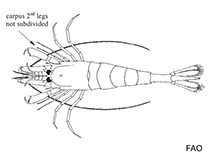
Malacostraca |
Decapoda |
Crangonidae
Entorno: milieu / zona climática / rango de profundidad / gama de distribución
Ecología
Benthic; salobre; rango de profundidad 5 - 50 m (Referencia 346). Temperate; 62°N - 36°N, 155°W - 121°W
Eastern Pacific: Alaska to Central California.
Longitud en la primera madurez / Tamaño / Peso / Edad
Madurez: Lm 3.6 range ? - ? cm Max length : 6.0 cm TL macho / no sexado; (Referencia 101956); 8 cm TL (female)
Feeds on various crustaceans, polychaetes, mollusks and fish (Refs. 101967. 104050). Predators include seabirds and fish (Refs. 4420, 32651) (Ref. 346).
Protandry with primary females; some males reproduce and later change sex during fall and winter (Ref. 101941), repeat spawners with molting in between spawning (Ref. 101948, 101956). Eggs are carried under the abdomen in between the pleopods. Life cycle: Eggs hatch into free-swimming larval stages, and later develop into adult benthic form (Ref. 101956).
Williams, A.B., L.G. Abele, D.L. Felder, H.H. Hobbs Jr., R.B. Manning, P.A. McLaughlin and I. Pérez Farfante 1988 Common and scientific names of aquatic invertebrates from the United States and Canada: decapod crustaceans. American Fisheries Society Special Publication 17. 77 pp. + 12 figs. (Referencia 2214)
Situación en la Lista Roja de la UICN
(Referencia 130435: Version 2025-2 (Global))
Estatus CITES (Referencia 108899)
Not Evaluated
CMS (Referencia 116361)
Not Evaluated
Amenaza para el ser humano
Usos humanos
Pesquerías: comercial
FAO - Publication: search | FishSource |
Herramientas
Más información
Relacionados con el ser humanoSellos, monedas, varios
Fuentes de Internet
Estimaciones basadas en modelos
Vulnerabilidad pesquera
(Referencia 71543) |
Low vulnerability (10 of 100). |
Categoría de precios
(Referencia 80766): |
Very high. |