Gastropoda |
Lepetellida |
Fissurellidae
Umwelt: Milieu / Klimazone / Tiefenbereich / Verbreitungsgebiet
Ökologie
Benthic; tiefenbereich 0 - 15 m (Ref. 865). Temperate
Eastern Pacific and the Arctic: from Alaska to Baja California. Subtropical to polar.
Länge bei der ersten Reifung / Größe / Gewicht / Alter
Geschlechtsreife: Lm ? range ? - ? cm Max length : 7.5 cm TL Männchen/unbestimmt; (Ref. 865); common length : 7.0 cm SHL Männchen/unbestimmt; (Ref. 312)
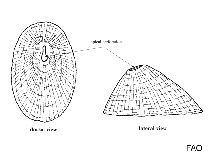
Description: Color is usually gray-brown and white. Radiating ribs of shell are both light and dark. There is a small opening at the peak (Ref. 312).
It has a shell length of 7 cm long (Ref. 312). Occurs at low intertidal zones. Omnivorous; encrusting bryozoans are sometimes consumed in preference to algae. When under attack by a sea star, it will extend its mantle flap over its foot and shell so that the tube feet of the star fish cannot grasp it (Ref. 312).
Lebenszyklus und Paarungsverhalten
Geschlechtsreife | Fortpflanzung | Ablaichen | Eier | Fruchtbarkeit | Larven
Members of the order Patellogastropoda are mostly gonochoric and broadcast spawners. Life cycle: Embryos develop into planktonic trocophore larvae and later into juvenile veligers before becoming fully grown adults.
Gallivan, G. and J. Danforth 1999 Phylum Mollusca. Marine Science Institute. (Ref. 312)
IUCN Rote Liste Status
(Ref. 130435: Version 2025-2 (Global))
CITES Status (Ref. 108899)
Not Evaluated
Not Evaluated
Bedrohung für Menschen
Nutzung durch Menschen
FAO - Publication: search | FishSource |
Tools
Mehr Information
PopulationsdynamikWachstum
Max. Alter/Größen
Länge-Gewicht-Rel.
Länge-Länge-Verhältnis.
Längenhäufigkeiten
Massenkonvertierung
Dichte
LebenszyklusFortpflanzungGeschlechtsreifeFruchtbarkeitAblaichenEierEientwicklungLarven PhysiologieSauerstoffverbrauch
MenschenbezogenBriefmarken, Münzen, Verschiedenes.
Internet Quellen
Schätzungen auf der Grundlage von Modellen
Anfälligkeit der Fischerei
(Ref. 71543) |
Low vulnerability (10 of 100). |
Preiskategorie
(Ref. 80766): |
Unknown. |