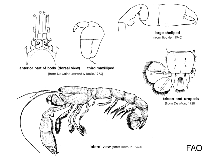
Malacostraca |
Decapoda |
Callianassidae
Environnement : milieu / zone climatique / profondeur / gamme de distribution
Écologie
Benthic; profondeur 0 - 4 m (Réf. 97531). Tropical
Western Central Atlantic: USA, Martinique, Virgin Islands, Belize and Jamaica.
Longueur à la première maturité / Taille / Poids / Âge
Maturité: Lm ? range ? - ? cm Max length : 13.0 cm TL mâle / non sexé; (Réf. 87256)
Often buries down to a meter among coarse sand and coral rubble at edges of lower intertidal and subtidal seagrass beds (Ref. 87256). Draws glass blades into their burrows (Ref. 86837). Deposit feeder (Ref. 86848), i.e., feeds on seagrass debris accumulated in their burrow chambers (Ref. 86850).
Cycle de vie et comportement reproducteur
Maturité | Reproduction | Frai | Œufs | Fécondité | Larves
Members of the order Decapoda are mostly gonochoric. Mating behavior: Precopulatory courtship ritual is common (through olfactory and tactile cues); usually indirect sperm transfer.
Felder, D.L., P.C. Dworschak, R. Robles, H.D. Bracken, A.M. Windsor, J.M. Felder and R. Lemaitre 2009 Obvious invaders and overlooked infauna: Unexpected contituents of the decapod crustacean assemblage at Twin Cays, Belize. p. 181-188. In M.A. Lang, I.G. Macintyre, and K. Ruetzler (eds.) Proceedings of the Smithsonian Marine Science Symposium. Smithsonian Contributions to the Marine Sciences. Vol. 38. Washington, D.C.: Smithsonian Institution Scholarly Press. (Réf. 86837)
Statut dans la liste rouge de l'IUCN
(Réf. 130435: Version 2025-2 (Global))
statut CITES (Réf. 108899)
Not Evaluated
Not Evaluated
Menace pour l'homme
Utilisations par l'homme
FAO - Publication: search | FishSource |
Outils
Plus d'informations
Dynamique des populationsCroissance
Âges / tailles maximales
Longueur-poids rel.
Rel. longueur-longueur.
Fréquences de longueurs
Conversion de masse
Abondance
Cycle de vieReproductionMaturitéFéconditéFraiŒufsDéveloppement de l'œufLarves PhysiologieConsommation d'oxygène
Liées à l'hommeTimbres, pièces de monnaie, divers
Sources Internet
Estimations basées sur des modèles
Vulnérabilité de la pêche
(Réf. 71543) |
Low vulnerability (10 of 100). |
Catégorie de prix
(Réf. 80766): |
Unknown. |