Malacostraca |
Decapoda |
Carcinidae
Entorno: milieu / zona climática / rango de profundidad / gama de distribución
Ecología
Benthic; salobre; rango de profundidad 0 - 200 m (Referencia 2779), usually 0 - 6 m (Referencia 114208). Subtropical; -1°C - 22°C (Referencia 114208), preferred 12°C (Referencia 107945); 70°N - 22°N, 20°W - 19°E (Referencia 114232)
Eastern Atlantic: From Great Britain north to Iceland, the North Sea and Norway, south to Portugal and Spain to Mauritania. Introduced and established in North America, South Africa (Cape Town), and Australia. Introduced but not established in Panama, Brazil, Pakistan, Sri Lanka, Madagascar, Myanmar, Japan and Hawaii. Subtropical to polar.
Longitud en la primera madurez / Tamaño / Peso / Edad
Madurez: Lm ?, range 1 - 4.5 cm Max length : 6.0 cm CL macho / no sexado; (Referencia 435); common length : 4.0 cm CL macho / no sexado; (Referencia 435); edad máxima reportada: 7 años (Referencia 128193)
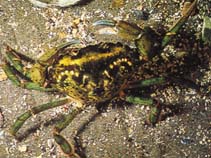
Usually found in eelgrass beds (Ref. 128717). Maximum carapace width: 7.7 cm; commonly 5 cm wide. Inhabits shallow water from the intertidal area down to 200 m. Lives under stones, on muddy or muddy sand bottoms, or hard bottom, etc. Also inhabits brackish lagoons (Ref. 2779), and eelgrass beds (Ref. 128717).
Members of the order Decapoda are mostly gonochoric. Mating behavior: Precopulatory courtship ritual is common (through olfactory and tactile cues); usually indirect sperm transfer (Ref. 833). Berried females migrate from littoral areas to more saline and deeper water (8-10 m) until hatching of eggs; afterwhich, they go back to moult and copulate (Ref. 128197). Larger females can breed twice or thrice annually (Ref. 128203).
Fischer, W., G. Bianchi and W.B. Scott (eds.) 1981 True Crabs. 6: pag.var. In FAO species identification sheets for fishery purposes. Eastern Central Atlantic (fishing areas 34, 47; in part). Canada Funds-in-Trust. Ottawa, Department of Fisheries and Oceans Canada, by arrangement with the Food and AgriculturesOrganization of the United Nations, 1-7: pag.var. (Referencia 435)
Situación en la Lista Roja de la UICN
(Referencia 130435: Version 2025-2 (Global))
Estatus CITES (Referencia 108899)
Not Evaluated
CMS (Referencia 116361)
Not Evaluated
Amenaza para el ser humano
Usos humanos
Pesquerías: comercial
FAO - pesquerías: landings search; Publication: search | FishSource | Sea Around Us
Herramientas
Más información
FisiologíaConsumo del oxígeno
Relacionados con el ser humanoSellos, monedas, varios
Fuentes de Internet
Estimaciones basadas en modelos
Vulnerabilidad pesquera
(Referencia 71543) |
Low to moderate vulnerability (28 of 100). |
Vulnerabilidad climática
(Referencia 125649) |
Low to moderate vulnerability (27 of 100) |
Categoría de precios
(Referencia 80766): |
Very high. |
Nutrients
|
Calcium = 109 [35, 184] mg/100g; Iron = 1.59 [1.21, 1.97] mg/100g; Protein = 20.2 [19.2, 21.3] %; Omega3 = 0.285 [0.185, 0.386] g/100g; Selenium = 48.3 [-31.7, 128.3] μg/100g; VitaminA = 0 μg/100g; Zinc = 1.79 [1.17, 2.40] mg/100g (wet weight); based on nutrient studies. |