Malacostraca |
Decapoda |
Cancridae
Môi trường: môi trường / vùng khí hậu / Mức độ sâu / phạm vi phân phối
Sinh thái học
Benthic; mức độ sâu 0 - 800 m (Tài liệu tham khảo 367). Subtropical, preferred 11°C (Tài liệu tham khảo 107945); 59°N - 20°N, 85°W - 52°W
Western Atlantic: from Newfoundland and Labrador, Canada to Dry Tortugas, Florida and Cuba.
Chiều dài lúc trưởng thành đầu tiên / Bộ gần gũi / Khối lượng (Trọng lượng) / Tuổi
Chín muồi sinh dục: Lm 8.8 range ? - ? cm Max length : 16.0 cm CW con đực/không giới tính; (Tài liệu tham khảo 101412); Khối lượng cực đại được công bố: 0.00 g
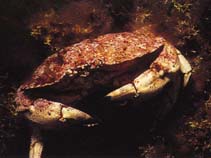
Carapace approximately 2/3 as long as wide, surface coarsely granulate; front (excluding inner orbital angles) with 3 teeth, middle one exceeding others and depressed (flattened dorsoventrally); anterolateral margins divided into 9 quadrangular lobes or teeth with margins minutely denticulate; notches between teeth continued on carapace as short, closed fissures. Pincers stout, nearly as long as second legs, carpus and hand with strong granulose rugae, upper margin of pincers denticulate, carpus with sharp inner dorsal spine. Color: red dorsally, yellow ventrally; back with 2 curved lines of yellowish spots and behind middle, a figure somewhat resembling letter H; legs mottled and reticulated with yellow and red, more or less purplish.
Minimum depth from Ref. 97531. Lives in deep water (Ref. 106868). Occurs from the intertidal zone among rocks to 800 m (Ref. 367). Common in shallow subtidal zone during summer (Ref. 106868). Small to medium-sized individuals are found near shore seasonally (especially in the south), while larger ones only occur in deeper water (Ref. 367). Moves from subtidal into low intertidal with the tide (Ref. 106868). Found in rocky bottom in association with Homarus americanus. Also on rubble and soft substrate (Ref. 97531). Feeds mainly on mollusks, echinoderms, and other invertebrates (Ref. 367). Preyed upon by gulls (Ref. 106868).
Vòng đời và hành vi giao phối
Chín muồi sinh dục | Sự tái sinh sản | Đẻ trứng | Các trứng | Sự sinh sản | Ấu trùng
Members of the order Decapoda are mostly gonochoric. Mating behavior: Precopulatory courtship ritual is common (through olfactory and tactile cues); usually indirect sperm transfer.
Tavares, M. 2003 True Crabs. pp. 327-352. In Carpenter, K.E. (ed.) The living marine resources of the Western Central Atlantic. Volume1: introdution, molluscs, crustaceans, hagfishes, sharks, batoid fishes, and chimaeras. FAO Species Identification Guide for Fishery Purposes and American Society of Ichthyologists and Herpetologists Special PublicationNo. 5. Rome, FAO. pp. 1-600. (Tài liệu tham khảo 367)
Tình trạng Sách đỏ IUCN
(Tài liệu tham khảo 130435: Version 2025-2 (Global))
tình trạng CITES (Tài liệu tham khảo 108899)
Not Evaluated
CMS (Tài liệu tham khảo 116361)
Not Evaluated
Mối đe dọa đối với con người
Sử dụng của con người
Các nghề cá: tính thương mại
FAO - Các nghề cá: landings search; Publication: search | FishSource | Biển chung quanh ta
Các công cụ
Thêm thông tin
Sinh lý họcThành phần ô-xy
Liên quan đến con ngườiTem, tiền xu, v.v.
Các nguồn internet
Ước tính dựa trên mô hình
Sự dễ bị tổn thương của nghề đánh cá
(Tài liệu tham khảo 71543) |
Low vulnerability (10 of 100). |
Sự dễ bị tổn thương của khí hậu
(Tài liệu tham khảo 125649) |
Low to moderate vulnerability (30 of 100) |
Loại giá
(Tài liệu tham khảo 80766): |
Very high. |
Nutrients
|
Calcium = 109 [35, 184] mg/100g; Iron = 1.59 [1.21, 1.97] mg/100g; Protein = 20.2 [19.2, 21.3] %; Omega3 = 0.285 [0.185, 0.386] g/100g; Selenium = 48.3 [-31.7, 128.3] μg/100g; VitaminA = 0 μg/100g; Zinc = 1.79 [1.17, 2.40] mg/100g (wet weight); based on nutrient studies. |