Malacostraca |
Decapoda |
Portunidae
Umwelt: Milieu / Klimazone / Tiefenbereich / Verbreitungsgebiet
Ökologie
Benthopelagisch; tiefenbereich 0 - 379 m (Ref. 367), usually 0 - 92 m. Tropical
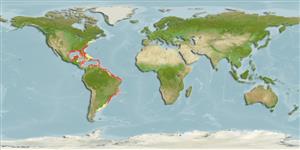
Western Atlantic: from USA to Colombia. Tropical to temperate.
Länge bei der ersten Reifung / Größe / Gewicht / Alter
Geschlechtsreife: Lm ? range ? - ? cm Max length : 12.2 cm WD Männchen/unbestimmt; (Ref. 367); 9.5 cm WD (female)
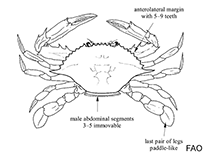
Carapace more than twice as broad as long; 9 blunt teeth (outer orbital tooth and strong lateral spine included) on arched anterolateral margin; front bearing 4 teeth (excluding inner orbital angles), inner pair small but definitely formed. Much of convex dorsal surface lightly and uniformly granulate in addition to transverse lines of fine granulations; central trapezoidal (metagastric) area short and wide (anterior width about 2.75 times, posterior width about 1.7 times length). Pincers dissimilar, with very fine granules on longitudinal ridges; fifth legs flattened in form of paddles. Male with sixth (penultimate) segment of T-shaped abdomen broader than telson, flush with sternum in retracted position; first pleopods well separated and reaching anteriorly 2/3 length of thoracic sternite 7 or beyond, distal part slender, extending straight to tips curved slightly inward, armed with minute retrogressive spinules. Color: carapace green dorsally, irregular areas of iridescence at bases of and between anterolateral teeth, and on posterior and posterolateral border. Chelipeds and portions of legs similar in color more tannish green dorsally, with iridescent areas on outer surface, with fuchsia on tips of fingers and teeth of opposed edges. Lateral spines and some anterolateral teeth as well as spines on chelipeds white-tipped. Walking legs grading from fuchsia distally through violet blue to light blue mottled with white proximally, pubescence on legs beige. Swimming legs variably mottled with white; all legs with stellate fuchsia markings at articulations. Underparts white blue.
Benthopelagic (Ref. 97531). Inhabits marine littoral water, seldom in estuaries. Found in salinities ranging from 24.9 to 37.4 ppm and temperatures between 13 and 29°C, at depths down to 92 m, recorded occasionally to 379 m. Usually associated with Callinectes sapidus. Feeds on plant fragment, fish remains, polychaetes, crustaceans (Farfantepenaeus aztecus and Portunus gibbesii), micromollusks (Mulinia lateralis) and detritus.
Lebenszyklus und Paarungsverhalten
Geschlechtsreife | Fortpflanzung | Ablaichen | Eier | Fruchtbarkeit | Larven
Members of the order Decapoda are mostly gonochoric. Mating behavior: Precopulatory courtship ritual is common (through olfactory and tactile cues); usually indirect sperm transfer.
Tavares, M. 2003 True Crabs. pp. 327-352. In Carpenter, K.E. (ed.) The living marine resources of the Western Central Atlantic. Volume1: introdution, molluscs, crustaceans, hagfishes, sharks, batoid fishes, and chimaeras. FAO Species Identification Guide for Fishery Purposes and American Society of Ichthyologists and Herpetologists Special PublicationNo. 5. Rome, FAO. pp. 1-600. (Ref. 367)
IUCN Rote Liste Status
(Ref. 130435: Version 2025-2 (Global))
CITES Status (Ref. 108899)
Not Evaluated
Not Evaluated
Bedrohung für Menschen
Nutzung durch Menschen
Fischereien: kommerziell
FAO - Publication: search | FishSource |
Tools
Mehr Information
PopulationsdynamikWachstumMax. Alter/GrößenLänge-Gewicht-Rel.Länge-Länge-Verhältnis.LängenhäufigkeitenMassenkonvertierungDichte LebenszyklusFortpflanzungGeschlechtsreifeFruchtbarkeitAblaichenEierEientwicklungLarven PhysiologieSauerstoffverbrauch
MenschenbezogenBriefmarken, Münzen, Verschiedenes.
Internet Quellen
Schätzungen auf der Grundlage von Modellen
Anfälligkeit der Fischerei
(Ref. 71543) |
Low vulnerability (10 of 100). |
Preiskategorie
(Ref. 80766): |
Very high. |