Malacostraca |
Decapoda |
Portunidae
Environnement : milieu / zone climatique / profondeur / gamme de distribution
Écologie
Benthopélagique; saumâtre; profondeur 1 - 421 m (Réf. 105052). Tropical; 35°N - 31°S, 82°W - 14°E
Atlantic Ocean: from southeastern Florida to Brazil rarely in Bermuda and North Carolina, also in the Cape Verde Islands and along the African coast from Mauritania to Angola.
Longueur à la première maturité / Taille / Poids / Âge
Maturité: Lm ? range ? - ? cm Max length : 10.0 cm CW mâle / non sexé; (Réf. 417)
In shallow littoral environments, typically from intertidal pools to 3 m (Ref. 105199). Inhabits shallow salt water on sandy or sandy mud bottom (Ref. 435) in brackish waters of estuaries (Ref. 417). Also found on algae and grass flats, sandy beaches, rocky pools, eroded coral bases (Ref. 105199), coral reef (Ref. 121879), oyster bars (Ref. 105199), and edge of mangroves (Refs. 105199, 121880). Rarely found in the open sea, from the intertidal to depth of 25 m (Ref. 121880). Associated with the barnacle Chelonibia sp. (Ref. 105200). In general, portunids are opportunistic omnivores with preference for animal prey (Ref. 100840).
Cycle de vie et comportement reproducteur
Maturité | Reproduction | Frai | Œufs | Fécondité | Larves
Members of the order Decapoda are mostly gonochoric. Mating behavior: Precopulatory courtship ritual is common (through olfactory and tactile cues); usually indirect sperm transfer.
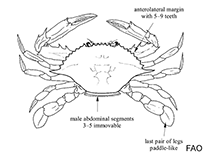
Fischer, W., G. Bianchi and W.B. Scott (eds.) 1981 True Crabs. 6: pag.var. In FAO species identification sheets for fishery purposes. Eastern Central Atlantic (fishing areas 34, 47; in part). Canada Funds-in-Trust. Ottawa, Department of Fisheries and Oceans Canada, by arrangement with the Food and AgriculturesOrganization of the United Nations, 1-7: pag.var. (Réf. 435)
Statut dans la liste rouge de l'IUCN
(Réf. 130435: Version 2025-2 (Global))
statut CITES (Réf. 108899)
Not Evaluated
Not Evaluated
Menace pour l'homme
Utilisations par l'homme
Pêcheries: commercial
FAO - Publication: search | FishSource |
Outils
Plus d'informations
Écologie trophiqueAliments (proies)
Composition du régime alimentaire
Consommation alimentaire
Prédateurs
Dynamique des populations Cycle de vieReproductionMaturitéFéconditéFraiŒufsDéveloppement de l'œufLarves PhysiologieConsommation d'oxygène
Liées à l'hommeTimbres, pièces de monnaie, divers
Sources Internet
Estimations basées sur des modèles
Vulnérabilité de la pêche
(Réf. 71543) |
Low vulnerability (10 of 100). |
Catégorie de prix
(Réf. 80766): |
Very high. |