Malacostraca |
Decapoda |
Portunidae
Environnement : milieu / zone climatique / profondeur / gamme de distribution
Écologie
Benthopélagique; eau douce; saumâtre; profondeur 0 - 40 m (Réf. 101596). Tropical; 34°N - 28°S, 98°W - 34°W
Western Atlantic: USA to Brazil.
Longueur à la première maturité / Taille / Poids / Âge
Maturité: Lm ? range ? - ? cm Max length : 16.0 cm WD mâle / non sexé; (Réf. 367); 15 cm WD (female)
Description synthétique
Morphologie
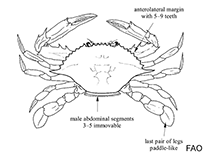
Carapace almost twice as broad as long; 9 teeth on moderately arched anterolateral margin, all except outer orbital teeth and strong lateral spine swept, forward front (excluding inner orbital angles) bearing 4 well-developed teeth (excluding outer orbital angles), outer pair obtuse. Marginal slopes of convex dorsal surface smooth and glistening (when wet), central part and transverse lines granulate. Pincers remarkably smooth except for usual spines, obsolescent granules on ridges; fingers of major hand heavily toothed; fifth legs flattened in form of paddles. Male with T-shaped abdomen reaching nearly to juncture between thoracic sternites 3 and 4; slender first pleopods sinuously curved, overlapping in 2 places proximally, diverging distally but often exceeding telson, crossed near tips and armed distally with dorsolateral band of large and small retrogressive spinules. Color: variable. Overall cast olive green with prominent reddish markings. Carapace olive, greyish green, greenish chestnut or forest green with variable purplish to red markings, especially on branchial, hepatic, cardiac, and gastric areas, individuals of large sizes are sometimes dark chestnut tinted blackish brown on gastric and metagastric areas, with an oblique spot on subbranchial region; anterolateral teeth olive green with brown to red tints and yellowish white tips. Chelipeds red to dark reddish brown above and whitish below with bluish tints, main colors being sharply separated on outer surface of palm; fingers red to reddish brown, a purplish cast on internal articulation of merus with carpus and this member with chela; tubercles, tips of fingers and spines, on articulations cream; remaining legs reddish, variable. Underparts of body mainly dirty white to purplish red with suffusion of blue marginally.
Benthopelagic (Ref. 97531). Inhabits shallow brackish waters ranging in salinity from nearly fresh to nearly full marine, on sand or rock-shell bottoms. Tolerant of stagnant polluted environments. Feeds on a variety of materials including mollusks, other bottom invertebrates, some fishes, carrion and detritus (Ref. 367).
Cycle de vie et comportement reproducteur
Maturité | Reproduction | Frai | Œufs | Fécondité | Larves
Members of the order Decapoda are mostly gonochoric. Mating behavior: Precopulatory courtship ritual is common (through olfactory and tactile cues); usually indirect sperm transfer.
Tavares, M. 2003 True Crabs. pp. 327-352. In Carpenter, K.E. (ed.) The living marine resources of the Western Central Atlantic. Volume1: introdution, molluscs, crustaceans, hagfishes, sharks, batoid fishes, and chimaeras. FAO Species Identification Guide for Fishery Purposes and American Society of Ichthyologists and Herpetologists Special PublicationNo. 5. Rome, FAO. pp. 1-600. (Réf. 367)
Statut dans la liste rouge de l'IUCN
(Réf. 130435: Version 2025-2 (Global))
statut CITES (Réf. 108899)
Not Evaluated
Not Evaluated
Menace pour l'homme
Utilisations par l'homme
Pêcheries: commercial
FAO - Publication: search | FishSource |
Outils
Plus d'informations
Dynamique des populationsCroissanceÂges / tailles maximalesLongueur-poids rel.Rel. longueur-longueur.Fréquences de longueursConversion de masseAbondance Cycle de vieReproductionMaturitéFéconditéFraiŒufsDéveloppement de l'œufLarves PhysiologieConsommation d'oxygène
Liées à l'hommeTimbres, pièces de monnaie, divers
Sources Internet
Estimations basées sur des modèles
Vulnérabilité de la pêche
(Réf. 71543) |
Low vulnerability (10 of 100). |
Catégorie de prix
(Réf. 80766): |
Very high. |