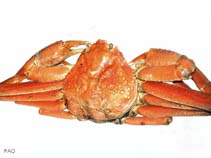
Malacostraca |
Decapoda |
Oregoniidae
Environnement : milieu / zone climatique / profondeur / gamme de distribution
Écologie
Benthic; profondeur 4 - 1400 m (Réf. 119370), usually 100 - 300 m (Réf. 117890). Boreal; -1°C - 10°C (Réf. 78815), preferred 3°C (Réf. 107945); 79°N - 29°N, 20°E - 43°W
Northern Pacific, Northern Atlantic and the Arctic. Introduced to the Northeast Atlantic (Barents Sea) and the Arctic (Kara Sea). Boreal to polar.
Longueur à la première maturité / Taille / Poids / Âge
Maturité: Lm 5.0, range 5 - ? cm Max length : 13.7 cm CW mâle / non sexé; (Réf. 127428); poids max. publié: 864.00 g (Réf. 127428)
Sediments mostly consisted of fine brown mud, either with or without nodules, pebbles and foraminiferans (Ref. 119389). Also found on sandy and gravelly bottoms (Ref. 119370). With year round temperatures 0 to 5°C (Ref. 78817). Exhibits cannibalism (Ref. 101157).
Cycle de vie et comportement reproducteur
Maturité | Reproduction | Frai | Œufs | Fécondité | Larves
Members of the order Decapoda are mostly gonochoric. Mating behavior: Precopulatory courtship ritual is common (through olfactory and tactile cues); usually indirect sperm transfer.
Kon, T., T. Adachi and Y. Suzuki 2003 Distribution of snow crab, Chionoecetes spp., larvae off Wakasa Bay in the Sea of Japan. Fisheries Science 69:1109-1115. (Réf. 93379)
Statut dans la liste rouge de l'IUCN
(Réf. 130435: Version 2025-2 (Global))
statut CITES (Réf. 108899)
Not Evaluated
Not Evaluated
Menace pour l'homme
Utilisations par l'homme
Pêcheries: commercial
FAO - pêcheries: Résumé espèce, landings search; Publication: search | FishSource | Sea Around Us
Outils
Plus d'informations
Dynamique des populations PhysiologieConsommation d'oxygène
Liées à l'hommeTimbres, pièces de monnaie, divers
Sources Internet
Estimations basées sur des modèles
Rate of population increase
|
Prior r = 0.58, 95% CL = 0.38 - 0.87, Based on 4 full stock assessments. |
Vulnérabilité de la pêche
(Réf. 71543) |
Low vulnerability (10 of 100). |
Vulnérabilité climatique
(Réf. 125649) |
Moderate vulnerability (38 of 100) |
Catégorie de prix
(Réf. 80766): |
Very high. |
Nutrients
|
Calcium = 109 [35, 184] mg/100g; Iron = 1.59 [1.21, 1.97] mg/100g; Protein = 20.2 [19.2, 21.3] %; Omega3 = 0.285 [0.185, 0.386] g/100g; Selenium = 48.3 [-31.7, 128.3] μg/100g; VitaminA = 0 μg/100g; Zinc = 1.79 [1.17, 2.40] mg/100g (wet weight); based on nutrient studies. |