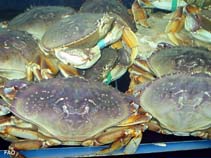
Malacostraca |
Decapoda |
Cancridae
محیط زیست: محیط زیست / منطقه آب و هوایی / تغييرات عمق / محدوده توزیع
بوم شناسي
Benthic; لب شور; تغييرات عمق 0 - 360 m (مرجع 865). Temperate; 3°C - 19°C (مرجع 104779), preferred 9°C (مرجع 107945); 61°N - 23°N, 179°W - 110°W
Eastern Pacific: Aleutian Islands, Alaska to Magdalena Bay, Mexico. Subtropical to boreal.
طول در اولین بلوغ / اندازه / وزن / سن
بلوغ: Lm ?, range 10 - ? cm Max length : 22.5 cm CW جنس نر / بدون خواص جنسي; (مرجع 865); 16 cm CW (female); بيشينه سن گزارش شده: 10 سال ها (مرجع 104779)
Maximum length for females from Ref. 104779. Epibenthic in estuaries and nearshore environments (Ref. 104211). It is found on soft bottoms in very low intertidal areas to a depth of 360 meters (Ref. 865). Found on seagrasses (Refs. 104216, 106869). Juveniles inhabit and forage on estuaries, particularly in oyster reefs, oyster beds (Ref. 104211, 113901), and eelgrass (Ref. 104211).
Life cycle: The fertilized egg hatches into prezoeae larva and molts into zoea an hour after. The larvae undergo five zoeal stages before molting into megalopae. The megalopae molts into juvenile stage before further molting (at most 12 times) into adult stage (Ref. 104779). Mating behavior: Precopulatory courtship ritual is common (through olfactory and tactile cues); usually indirect sperm transfer (Ref. 833). Males locate premolt females through a pheremonal homing system. Male holds the female in an embrace for at most 7 days prior to the female's molting. An hour after molting, copulation occurs through insertion of male gonopods into the spermathecae of the female to deposit sperm (indirect sperm transfer). The female may then be embraced again for 2 days. Pre- and post-mating embraces are done to protect females from predation, aside from insuring mating success. Mating occurs in estuaries but spawning takes place offshore (Ref. 104779). Crabs can store and utilize sperm for at least 2 years. Eggs are fertilized as they pass through the spermathecae during extrusion (Ref. 104787).
مآخذ اصلی
مراجع | هماهنگ كننده | همكاران
Shirley, S.M., T.C. Shirley and S.D. Rice 1987 Latitudinal variation in the Dungeness crab, Cancer magister: zoeal morphology explained by incubation temperature. Mar. Biol. 95(3):371-376. (مرجع 8391)
وضعيت در فهرست قرمز IUCN
(مرجع 130435: Version 2025-2 (Global))
وضعيت از نظر سايتس (مرجع 108899)
Not Evaluated
Not Evaluated
خطر برای انسان ها
استفاده انسانی
ماهي گيري – شيلات: تجاري
FAO - ماهي گيري – شيلات: نمايه گونه, landings search; Publication: search | FishSource | دریای اطراف ما
ابزارها
اطلاعات بيشتر
مرتبط با انسانتمبر، سکه، متفرقه.
منابع اينترنتي
تخمینها بر اساس مدلها
Rate of population increase
|
Prior r = 0.57, 95% CL = 0.37 - 0.85, Based on 3 data-limited stock assessments. |
آسیبپذیری ماهیگیری
(مرجع 71543) |
Low to moderate vulnerability (31 of 100). |
آسیبپذیری اقلیمی
(مرجع 125649) |
Moderate to high vulnerability (51 of 100) |
طبقه قيمت
(مرجع 80766): |
Very high. |
Nutrients
|
Calcium = 109 [35, 184] mg/100g; Iron = 1.59 [1.21, 1.97] mg/100g; Protein = 20.2 [19.2, 21.3] %; Omega3 = 0.285 [0.185, 0.386] g/100g; Selenium = 48.3 [-31.7, 128.3] μg/100g; VitaminA = 0 μg/100g; Zinc = 1.79 [1.17, 2.40] mg/100g (wet weight); based on nutrient studies. |