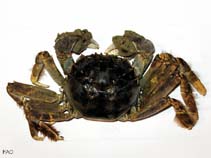
Malacostraca |
Decapoda |
Varunidae
Environnement : milieu / zone climatique / profondeur / gamme de distribution
Écologie
Benthic; catadrome (Réf. 137698); eau douce; saumâtre; profondeur 0 - 25 m (Réf. 81172). Temperate; 5°C - 27°C (Réf. 8003); 44°N - 21°N, 112°E - 127°E
Northwest Pacific: from Yangtze River to the west coast of North Korea, south to Taiwan. Introduced to North America, Europe, Japan, and Singapore.
Longueur à la première maturité / Taille / Poids / Âge
Maturité: Lm ? range ? - ? cm Max length : 7.5 cm CW mâle / non sexé; (Réf. 3159)
Catadromous (Ref. 101972). Maximum depth from Ref. 104445. Euryhaline (Ref. 115548). Catadromous (Ref. 115520, 115522, 137698), spending most of its life growing to maturity in freshwater (Ref. 115522). Found in coastal rivers and estuaries. It needs brackish or saltwater to reproduce (Ref. 8778). Downstream migration of adults occurs worldwide (Ref. 115548). From sublittoral sediment and surface running water (Ref. 104191). Adults are found in fresh, brackish and salt waters; oviparous females are typically in greatest number in saltwater (Ref. 115548). Has high affinity to burrow. Juveniles are known to form burrows in soft-sediment banks between high and low tide lines upon migration into brackish channels and creeks. In general, small juveniles construct and inhabit these burrows (Ref. 104191). Larger crabs occasionally burrow in softer substrate of freshwater stream banks. When abundance increases, burrows can become very dense, causing bank weakening, erosion, loss of bank vegetation, and bank collapse (Ref. 115547). In Germany, burrows reached 50 cm deep, which caused considerable damage (Ref. 115521). Predominantly omnivorous; however, it exhibits plasticity in its diet (i.e., feeding habits may shift throughout the cycle). Likely to scavenge and feed on detritus (Ref. 104191). Larvae feed on phytoplankton; newly settled juveniles feed on aquatic plants (Ref. 115548). Shifts to a more carnivorous diet as it ages, eating shrimp and other benthic invertebrates. Also reported to feed on fish captured in fishing nets (Ref. 104191). Opportunistic feeder (Ref. 115548). Feeds on periphytic algae, terrestrial plants, detritus, sand, copepods and chironomid larvae (Ref. 107018). Carries a lung fluke trematode parasite Paragonimus westermani that infects humans (Ref. 115522).
Cycle de vie et comportement reproducteur
Maturité | Reproduction | Frai | Œufs | Fécondité | Larves
Life cycle: Eggs are carried until hatched and the adults die afterwards. The larvae undergo five zoeal stages. Juveniles migrate from the estuary to the freshwater to develop into adults. Adults migrate downstream, mating occurs in saline water.
Ray, G.L. 2005 Invasive Animal Species in Marine and Estuarine Environments: Biology and Ecology. Aquatic Nuisance Species Research Program. (Réf. 3159)
Statut dans la liste rouge de l'IUCN
(Réf. 130435: Version 2025-2 (Global))
statut CITES (Réf. 108899)
Not Evaluated
Not Evaluated
Menace pour l'homme
Utilisations par l'homme
Pêcheries: commercial
FAO - Aquaculture Systems: Résumé espèce, production search; pêcheries: Résumé espèce, landings search; Publication: search | FishSource | Sea Around Us
Outils
Plus d'informations
Dynamique des populations PhysiologieConsommation d'oxygène
Liées à l'hommeTimbres, pièces de monnaie, divers
Sources Internet
Estimations basées sur des modèles
Vulnérabilité de la pêche
(Réf. 71543) |
Low to moderate vulnerability (29 of 100). |
Catégorie de prix
(Réf. 80766): |
Unknown. |