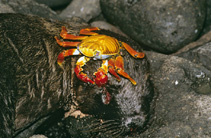
Malacostraca |
Decapoda |
Grapsidae
Umwelt: Milieu / Klimazone / Tiefenbereich / Verbreitungsgebiet
Ökologie
Benthic; tiefenbereich 0 - 5 m (Ref. 106471). Tropical; 40°N - 35°S, 126°W - 28°E
Indo-Pacific and Atlantic: from Baja California (Mexico) to Chile, including Clipperton Island, Galapagos Islands and other Pacific oceanic islands; from south Florida to central America, West Indies, to Colombia, Venezuela and Brazil, to western Africa and Portugal, including Azores, Cape Verde, Sao Tome and Principe, Ascension and Saint Helena. Subtropical and tropical.
Länge bei der ersten Reifung / Größe / Gewicht / Alter
Geschlechtsreife: Lm ?, range 3 - 3.38 cm Max length : 7.7 cm CL Männchen/unbestimmt; (Ref. 435)
Maximum carapace width: 8.7 cm. Inhabits rocks near water line and is very active on land, taking refuge in the sea when threatened (Ref. 435). Supralittoral to intertidal (Ref. 104055). Abundant in splash zones (Ref. 105697). On rubbles (Ref. 106471). Feeds on cirripedes, mytilids, and porcelain crabs; occasionally acts as a scavenger. Also preys upon sea turtles and on the lookout for marine birds nest (Ref. 106452). Herbivorous (Ref. 106455).
Lebenszyklus und Paarungsverhalten
Geschlechtsreife | Fortpflanzung | Ablaichen | Eier | Fruchtbarkeit | Larven
Members of the order Decapoda are mostly gonochoric. Mating behavior: Precopulatory courtship ritual is common (through olfactory and tactile cues); usually indirect sperm transfer.
Fischer, W., G. Bianchi and W.B. Scott (eds.) 1981 True Crabs. 6: pag.var. In FAO species identification sheets for fishery purposes. Eastern Central Atlantic (fishing areas 34, 47; in part). Canada Funds-in-Trust. Ottawa, Department of Fisheries and Oceans Canada, by arrangement with the Food and AgriculturesOrganization of the United Nations, 1-7: pag.var. (Ref. 435)
IUCN Rote Liste Status
(Ref. 130435: Version 2025-2 (Global))
CITES Status (Ref. 108899)
Not Evaluated
Not Evaluated
Bedrohung für Menschen
Nutzung durch Menschen
Fischereien: kleinfischerei
FAO - Publication: search | FishSource | Das Meer um uns herum
Tools
Mehr Information
PopulationsdynamikWachstumMax. Alter/GrößenLänge-Gewicht-Rel.Länge-Länge-Verhältnis.LängenhäufigkeitenMassenkonvertierungDichte PhysiologieSauerstoffverbrauch
MenschenbezogenBriefmarken, Münzen, Verschiedenes.
Internet Quellen
Schätzungen auf der Grundlage von Modellen
Anfälligkeit der Fischerei
(Ref. 71543) |
Low vulnerability (10 of 100). |
Preiskategorie
(Ref. 80766): |
Unknown. |