Gastropoda |
Not assigned |
Architectonicidae
Milieu: milieu / Klimaatzone / Diepte / verspreidingsgebied
Ecologie
Benthic; diepte 10 - 120 m (Ref. 349), usually 10 - 65 m (Ref. 349). Tropical
Indo-Pacific: from East Africa, including Madagascar, the Red Sea and the Persian Gulf, to eastern Polynesia; north to Japan and Hawaii, and south to eastern South Australia.
Lengte bij maturiteit / Grootte / Gewicht / Leeftijd
Maturiteit: Lm ? range ? - ? cm Max length : 7.0 cm SHL mannelijk / geslacht onbekend; (Ref. 721); common length : 5.0 cm SHL mannelijk / geslacht onbekend; (Ref. 349)
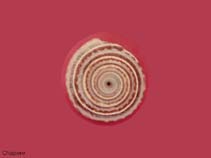
Shell: thin and strong, low spire, breadth more than double the height, whorls are only slightly convex, almost flat, sutures deeply incised; flat base has a fairly wide and deep umbilicus surrounded by a nodular swelling; thin aperture lip is nearly square in shape; sculpture of the body whorl consists of a broad and slightly raised band running below the suture and two narrower and more raised bands at the periphery, with another three on the basal side; all bands are granular as they intersect with the growth lines, which are fairly incised; coloration is light brown on either side of white stripes, following the bands of the sculpture; operculum is horny, dark brown, slightly spiral, roughly central nucleus and with a tubercle on the inner surface. Body: radula is ptenoglossan, without a rachidial tooth and with fourteen pairs of lateral teeth.
Occasional bycatch by shrimp trawlers (Ref. 349). Found on sandy, weedy bottoms (Ref. 799) and muddy bottoms, in sublittoral areas (Ref. 128042). In general, members of the family Architectonicidae are carnivores (Ref. 67623).
Levenscyclus en paargedrag
Maturiteit | Voortplanting | Paaien | Eieren | Fecunditeit | Larven
Members of the order Heterostropha are mostly simultaneous hermaphrodites.
Springsteen, F.J. and F.M. Leobrera 1986 Shells of the Philippines. Carfel Seashell Museum. Metro Manila, Philippines. 377 p. (Ref. 821)
Status op de Rode Lijst van het IUCN
(Ref. 130435: Version 2025-2 (Global))
CITES status (Ref. 108899)
Not Evaluated
Not Evaluated
Gevaar voor de mens
Gebruik door de mens
Visserij: commercieel
FAO - Publication: search | FishSource |
Tools
Meer informatie
Trofische ecologieVoedsel (prooien)
Dieetsamenstelling
Voedselconsumptie
Predatoren
FysiologieZuurstofverbruik
Menselijk gerelateerdPostzegels, munten, diversen.
Internetbronnen
Schattingen op basis van modellen
Kwetsbaarheid van de visserij
(Ref. 71543) |
Low vulnerability (10 of 100). |
Prijsklasse
(Ref. 80766): |
Unknown. |