Gastropoda |
Littorinimorpha |
Aporrhaidae
Lingkungan: lingkungan / zona iklim / kisaran kedalaman / jangkauan distribusi
Ekologi
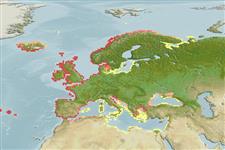
Benthic; kisaran kedalaman 6 - 8 m (Acuan 118694). Temperate; 76°N - 25°N, 31°W - 61°E
Northeast Atlantic, Arctic and the Mediterranean: North and Celtic seas. Temperate to polar.
Panjang pada saat jatuh tempo pertama / Ukuran / Berat / umur
Kematangan: Lm ? range ? - ? cmCommon length : 5.1 cm SHL jantan/; (Acuan 360)
Shell: quite high conical spire, with an outer lip characteristically broadened and fingered, looking like a bird's foot; whorls are angular with a nodular median keel (two in the body whorl); the suture is hardly incised; outer lip of the aperture is thickened, and the inner lip produces a marked columellar callus; development of the external fingers marks the attainment of maturity; sculpture consists of the nodular keel and thin spiral grooves that extend over the whole surface; coloration is variable, white, beige, darkish chestnut, reddish brown or patched, axially flamed with draker shades than the base color; operculum is horny, ellipsoidal and with a terminal nucleus. Body: pink or reddish with whitish spots, foot is very long and narrow; eyes sessile, set at the bases of the long tentacles; mantle cavity has one gill, the osphradium/penis; radula is taenioglossan.
This is a carnivorous species (Ref. 96498).
Siklus hidup dan perilaku kawin
Kematangan | Reproduksi, perkembang biakan | Pemijahan | telur-telur | Fekunditas | Larva
Members of the order Neotaenioglossa are mostly gonochoric and broadcast spawners. Life cycle: Embryos develop into planktonic trocophore larvae and later into juvenile veligers before becoming fully grown adults.
rujukan utama
Acuan | Koordinator | mitra
Sabelli, B. and H.S. Feinberg (eds.) 1879 Simon and Schuster's Guide to Shells. Simon and Schuster's Inc. New York. 512 pp. (Acuan 360)
Status IUCN Red List
(Acuan 130435: Version 2025-2 (Global))
status CITES (Acuan 108899)
Not Evaluated
Not Evaluated
ancaman kepada manusia
penggunaan manusia
FAO - Publication: search | FishSource |
Alat, peralatan
informasi lanjut
Ekologi trofikItem makanan (mangsa)
Komposisi makanan
Konsumsi makanan
Pemangsa
FisiologiKonsumsi oksigen
Yang berhubungan dengan manusiaPerangko, koin, dll.
Sumber internet
Estimasi berdasarkan model
Kerentanan Penangkapan Ikan
(Acuan 71543) |
(0 of 100). |
kategori harga
(Acuan 80766): |
Unknown. |