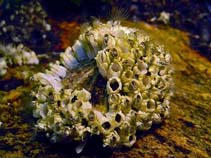
Thecostraca |
Balanomorpha |
Balanidae
Miljö: miljö / Klimatzon / djupintervall / distributionsområde
Ekologi
Sessile; brackvatten; djupintervall 1 - 182 m (Ref. 126559). Temperate
Arctic, Eastern Pacific, Northern Atlantic and the Mediterranean: Canadian Arctic Archipelago and British Isles.
Längd vid första mognad / Storlek / Vikt / Ålder
Könsmognad: Lm ? range ? - ? cm Max length : 2.0 cm WD hane/ej könsbestämd; (Ref. 3719)
Most commonly found in the subtidal zone, on the underside of smooth rocks, but very infrequently on highly brackish water. Individuals occur as fouling organisms on ship bottoms and docks, inside crab carapace, mussle shells, and plate limpets, also in bottles, wood, and kelp (Ref. 126559). Naupliar stage larvae are found in the water column and are flushed back into the sea with the fresh water outflow. Larvae migrate into estuaries at a later stage where they settle (Ref. 126559). Found in muddy substrates associated with organic pollutants (Ref. 96352) and on mixed sediments with gravel, pebbles and sand (Ref. 118257). This is an attached (Ref. 3123), epibenthic species (Ref. 95730). Suspension feeder (Ref. 118257). A microvore that feeds on organic detritus (Ref. 96352).
Livscykel och parningsbeteende
Könsmognad | Reproduktion | Lek | Ägg | Fekunditet | Larver
Members of the superorder Thoracica are mostly hermaphroditic. Broadcast spawners, fertilization occurs in the mantle cavity. Life cycle: Eggs hatch into planktonic nauplii and leave the mantle cavity. Afterwards, they undergo six naupliar instars succeded by nonfeeding cypris larva (settling stage) which later metamorphose into adults.
Organisation for Economic Co-operation and Development 1963 Volume 1. Barnacles. Catalogue of Main Marine Fouling Organisms. (Ref. 3719)
Status på IUCN:s rödlista
(Ref. 130435: Version 2025-2 (Global))
CITES-status (Ref. 108899)
Not Evaluated
Not Evaluated
Hot mot människor
Mänskliga användningsområden
FAO - Publication: search | FishSource |
Verktyg
Ytterligare information
PopulationsdynamikTillväxtMax. åldrar / storlekarLängd-vikt rel.Längd-längd rel.Längd-frekvenserMassakonverteringAbundans LivscykelReproduktionKönsmognadFekunditetLekÄggUtveckling av äggLarver MänniskorelateradFrimärken, mynt, diverse.
Internet-källor
Uppskattningar baserade på modeller
Sårbarhet i fisket
(Ref. 71543) |
Low vulnerability (10 of 100). |
Priskategori
(Ref. 80766): |
Unknown. |