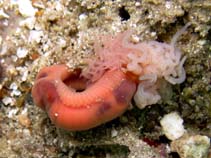
Polychaeta |
Terebellida |
Terebellidae
পরিবেশ: পরিবেশ / জলবায়ু অঞ্চল / গভীরতার পরিসীমা / বিতরণ পরিসীমা
বাস্তুসংস্থান
Sessile; গভীরতার পরিসীমা 43 - 53 m (সূত্র 112705). Tropical
Antarctic, Atlantic, the Mediterranean and Indo-Pacific.
প্রথম পরিপক্কতার সময় দৈর্ঘ্য / আকৃতি / ওজন / বয়স
পরিপক্কতা : Lm ? range ? - ? cm
Found on soft substrate (Ref. 112705) and under stones in shallow, protected waters (Ref. 107397). Tubiculous (Ref. 112705). A surface deposit-feeder (Ref. 96376).
জীবনচক্র এবং প্রজনন আচরণ
পরিপক্কতা | প্রজনন | ডিম ছাড়া | ডিমসমূহ | ডিম্বধারন ক্ষমতা | শুককীট
Members of the class Polychaeta are mostly gonochoric (sexual). Mating: Females produce a pheromone attracting and signalling the males to shed sperm which in turn stimulates females to shed eggs, this behavior is known as swarming. Gametes are spawned through the metanephridia or body wall rupturing (termed as "epitoky", wherein a pelagic, reproductive individual, "epitoke", is formed from a benthic, nonreproductive individual, "atoke"). After fertilization, most eggs become planktonic; although some are retained in the worm tubes or burrowed in jelly masses attached to the tubes (egg brooders). Life Cycle: Eggs develop into trocophore larva, which later metamorph into juvenile stage (body lengthened), and later develop into adults.
Salazar-Vallejo, S.I. and M.H. Londoño-Mesa 2004 Lista de especies y bibliografía de poliquetos (Polychaeta) del Pacífico Oriental Tropical. Anales del Instituto de Biología, Universidad Nacional Autónoma de México, Serie Zoología 75(1):9-97. (সূত্র 8159)
আইইউসিএন রেড লিস্টের অবস্থা
(সূত্র 130435: Version 2025-2 (Global))
CITES অবস্থা (সূত্র 108899)
Not Evaluated
Not Evaluated
মানুষের জন্য হুমকি
মানুষের ব্যবহার
FAO - Publication: search | FishSource |
হাতিয়ার
আরো তথ্য
জনসংখ্যার গতিশীলতাবৃদ্ধি
সর্বোচ্চ বয়স / আকার
দৈর্ঘ্য-ওজন সম্পর্ক।
দৈর্ঘ্য-দৈর্ঘ্য rel.
দৈর্ঘ্য-ফ্রিকোয়েন্সি
গণ রূপান্তর
প্রাচুর্য
জীবনচক্রপ্রজনন পরিপক্কতা ডিম্বধারন ক্ষমতা ডিম ছাড়া ডিমসমূহডিমের বিকাশশুককীট শারীরবিদ্যাঅম্লজান ব্যবহার
মানব সম্পর্কিতডাকটিকিট, মুদ্রা, বিবিধ।
ইন্টারনেট সুত্র
মডেলের উপর ভিত্তি করে অনুমান
মাছ ধরার ঝুঁকিপূর্ণতা
(সূত্র 71543) |
(0 of 100). |
মূল্য বিভাগ
(সূত্র 80766): |
Unknown. |