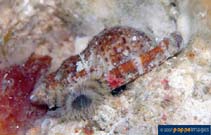
Polychaeta |
Sabellida |
Sabellidae
Environnement : milieu / zone climatique / profondeur / gamme de distribution
Écologie
Sessile. Tropical
Indo-Pacific.
Longueur à la première maturité / Taille / Poids / Âge
Maturité: Lm ? range ? - ? cm
Found in the intertidal and subtidal reefs (Ref. 102518). Larger species feed by filtering plankton and organic particles from the water column while smaller species can pick up organic matter from the sediments and filter feed organic matter (Ref. 107862).
Cycle de vie et comportement reproducteur
Maturité | Reproduction | Frai | Œufs | Fécondité | Larves
Members of the class Polychaeta are gonochoric (sexual), gametes are spawned through the metanephridia or body wall rupturing.
Fishelson, L. 1971 Ecology and distribution of the benthic fauna in the shallow waters of the Red Sea. Mar. Biol. 10:113-133. (Réf. 3565)
Statut dans la liste rouge de l'IUCN
(Réf. 130435: Version 2025-2 (Global))
statut CITES (Réf. 108899)
Not Evaluated
Not Evaluated
Menace pour l'homme
Utilisations par l'homme
FAO - Publication: search | FishSource |
Outils
Plus d'informations
Dynamique des populationsCroissance
Âges / tailles maximales
Longueur-poids rel.
Rel. longueur-longueur.
Fréquences de longueurs
Conversion de masse
Abondance
Cycle de vieReproductionMaturitéFéconditéFraiŒufsDéveloppement de l'œufLarves PhysiologieConsommation d'oxygène
Liées à l'hommeTimbres, pièces de monnaie, divers
Sources Internet
Estimations basées sur des modèles
Vulnérabilité de la pêche
(Réf. 71543) |
(0 of 100). |
Catégorie de prix
(Réf. 80766): |
Unknown. |