Polychaeta |
Canalipalpata |
Oweniidae
Umwelt: Milieu / Klimazone / Tiefenbereich / Verbreitungsgebiet
Ökologie
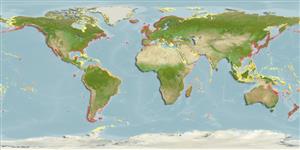
Benthic; brackwasser; tiefenbereich 3 - 237 m (Ref. 112705). Tropical
Indo-West Pacific, Atlantic Ocean, Arctic and the Mediterranean.
Länge bei der ersten Reifung / Größe / Gewicht / Alter
Geschlechtsreife: Lm ? range ? - ? cm Max length : 10.0 cm TL Männchen/unbestimmt; (Ref. 7882)
Species' maximum length from the Belgian part of the North Sea (Ref. 7882). Length based from occurrence record; to be replaced with better reference. Maximum depth from Ref. 117328. Inhabits sandbanks and muddy bottoms of estuaries and inshore areas (Ref. 96352) and along the near-coastal zone. A tube-dwelling bristle worm, preferring fine to coarse sediment with 10 to 40% mud content. Its flexible tube, longer than the worm itself and made up of cemented sand grains and shell fragments, allows it to withdraw inward and the tube to subsequently bend down (Ref. 7882). A filter- and suspension feeder (Ref. 75621). Capable of surface deposit feeding (Ref. 87179). Feeds on organic detritus (Ref. 96352) and small invertebrates (Ref. 87179).
Lebenszyklus und Paarungsverhalten
Geschlechtsreife | Fortpflanzung | Ablaichen | Eier | Fruchtbarkeit | Larven
Members of the class Polychaeta are mostly gonochoric (sexual). Mating: Females produce a pheromone attracting and signalling the males to shed sperm which in turn stimulates females to shed eggs, this behavior is known as swarming. Gametes are spawned through the metanephridia or body wall rupturing (termed as "epitoky", wherein a pelagic, reproductive individual, "epitoke", is formed from a benthic, nonreproductive individual, "atoke"). After fertilization, most eggs become planktonic; although some are retained in the worm tubes or burrowed in jelly masses attached to the tubes (egg brooders). Life Cycle: Eggs develop into trocophore larva, which later metamorph into juvenile stage (body lengthened), and later develop into adults.
López-Jamar, E., G. González and J. Mejuto 1986 Temporal changes of community structure and biomass in two subtidal macroinfaunal assemblages in La Coruña bay, NW Spain. Hydrobiologia 142:137-150. (Ref. 2778)
IUCN Rote Liste Status
(Ref. 130435: Version 2025-2 (Global))
CITES Status (Ref. 108899)
Not Evaluated
Not Evaluated
Bedrohung für Menschen
Nutzung durch Menschen
FAO - Publication: search | FishSource |
Tools
Mehr Information
LebenszyklusFortpflanzungGeschlechtsreifeFruchtbarkeitAblaichenEierEientwicklungLarven PhysiologieSauerstoffverbrauch
MenschenbezogenBriefmarken, Münzen, Verschiedenes.
Internet Quellen
Schätzungen auf der Grundlage von Modellen
Anfälligkeit der Fischerei
(Ref. 71543) |
Low vulnerability (10 of 100). |
Preiskategorie
(Ref. 80766): |
Unknown. |