Polychaeta |
Sabellida |
Serpulidae
Environnement : milieu / zone climatique / profondeur / gamme de distribution
Écologie
Récifal. Tropical
Circumtropical.
Longueur à la première maturité / Taille / Poids / Âge
Maturité: Lm ? range ? - ? cm Max length : 20.0 cm DL mâle / non sexé; (Réf. 81049)
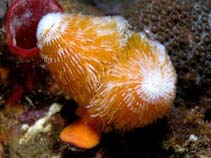
Calcareous tube can reach up to 20 cm in length and is usually deeply embedded in the coral skeleton. Planktonic larval phase lasts for 9 to 12 days and the average life span is over 30 years. A dioecious filter feeder that is often mistaken to be a boring species. Larvae actually settles on exposed corals skeleton and extend their tubes toward the living tissue, which subsequently obscures the tube. Simultaneous spawning of male and female species and its host corals (Orbicella annularis, O. faveolata, O. franksi, Montastraea cavernosa, Pseudodiploria strigosa), occurred in the evening during slack neap tides with nominal wind and wave action. Such conditions minimize gamete distribution by water turbulence and wave action, increasing the chances of fertilization (Ref. 81049). Part of fouling communities attached to raft frames in mariculture zones (Ref. 127121).
Cycle de vie et comportement reproducteur
Maturité | Reproduction | Frai | Œufs | Fécondité | Larves
Planktotrophic larval phase lasts for 9-12 days. Within the first 24 hrs the first larval ocelli (compound eyes) develop facilitating positive phototaxis to visible light of wavelengths shorter than 590nm.
Bisby, F.A., M.A. Ruggiero, K.L. Wilson, M. Cachuela-Palacio, S.W. Kimani, Y.R. Roskov, A. Soulier-Perkins and J. van Hertum 2005 Species 2000 & ITIS Catalogue of Life: 2005 Annual Checklist. CD-ROM; Species 2000: Reading, U.K. (Réf. 19)
Statut dans la liste rouge de l'IUCN
(Réf. 130435: Version 2025-2 (Global))
statut CITES (Réf. 108899)
Not Evaluated
Not Evaluated
Menace pour l'homme
Utilisations par l'homme
FAO - Publication: search | FishSource |
Outils
Plus d'informations
Écologie trophiqueAliments (proies)
Composition du régime alimentaire
Consommation alimentaire
Prédateurs
Dynamique des populationsCroissance
Âges / tailles maximales
Longueur-poids rel.
Rel. longueur-longueur.
Fréquences de longueurs
Conversion de masse
Abondance
PhysiologieConsommation d'oxygène
Liées à l'hommeTimbres, pièces de monnaie, divers
Sources Internet
Estimations basées sur des modèles
Vulnérabilité de la pêche
(Réf. 71543) |
Low vulnerability (10 of 100). |
Catégorie de prix
(Réf. 80766): |
Unknown. |