Hexacorallia |
Actiniaria |
Aiptasiidae
Entorno: milieu / zona climática / rango de profundidad / gama de distribución
Ecología
Sessile; rango de profundidad 0 - 50 m (Referencia 358). Subtropical
Atlantic and the Mediterranean: Azores Islands, Ireland to the Canary Islands.
Longitud en la primera madurez / Tamaño / Peso / Edad
Madurez: Lm ? range ? - ? cm
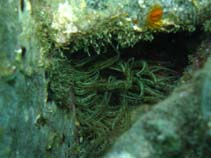
Diameter of the foot: 2.5 cm. Oral disc, tentacles not included/understood: 6 cm; cuts vertical, 20 cm. 136 tentacles: are laid out in 6 crowns around the siphonoglyphe; each one of them can measure up to 6 cm length. Coloring is fluctuating, rear related to the density of symbiotic algae, zooxanthella the, present ones within fabrics. The tentacles more or less transparent; and are avoided reasons in band or reticules, of white color to green, absent at ecotype I (Ref. 358).
Found on various rock funds, inside excavations and of cracks (Ref. 201). Known from infralittoral zones (Ref. 85338). Solitary (Ref. 2377).
Ciclo vital y comportamiento de apareamiento
Madurez | Reproducción | Puesta | Huevos | Fecundidad | Larva
Members of the class Anthozoa are either gonochoric or hermaphroditic. Mature gametes are shed into the coelenteron and spawned through the mouth. Life cycle: The zygote develops into a planktonic planula larva. Metamorphosis begins with early morphogenesis of tentacles, septa and pharynx before larval settlement on the aboral end.
Wirtz, P., O. Ocaña and T. Molodtsova 2003 Actiniaria and Ceriantharia of the Azores (Cnidaria Anthozoa). Helgoland Marine Research 57:114-117. (Referencia 201)
Situación en la Lista Roja de la UICN
(Referencia 130435: Version 2025-2 (Global))
Estatus CITES (Referencia 108899)
Not Evaluated
CMS (Referencia 116361)
Not Evaluated
Amenaza para el ser humano
Usos humanos
FAO - Publication: search | FishSource |
Herramientas
Más información
Ecología TróficaAlimentos (presas)
Composición de la dieta
consumo de alimento
Despredadores
Dinámica de la poblaciónCrecimientoEdades / tallas máximasLongitud-peso rel.Longitud-longitud rel.Longitud-frecuenciasConversión de masasAbundancia Ciclo de vidaReproducciónMadurezFecundidadPuestaHuevosDesarrollo de los huevosLarva FisiologíaConsumo del oxígeno
Relacionados con el ser humanoSellos, monedas, varios
Fuentes de Internet
Estimaciones basadas en modelos
Vulnerabilidad pesquera
(Referencia 71543) |
(0 of 100). |
Categoría de precios
(Referencia 80766): |
Unknown. |