Hexacorallia |
Actiniaria |
Actiniidae
Environnement : milieu / zone climatique / profondeur / gamme de distribution
Écologie
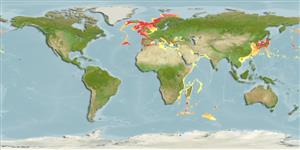
Sessile; profondeur 0 - 1600 m (Réf. 108103). Subtropical; 73°N - 36°S, 26°W - 143°E
North and South Atlantic, Mediterranean and Pacific: From Atlantic Europe to northern Russia, the Mediterranan, South Africa and Japan.
Longueur à la première maturité / Taille / Poids / Âge
Maturité: Lm ? range ? - ? cm Max length : 8.0 cm H mâle / non sexé; (Réf. 364)
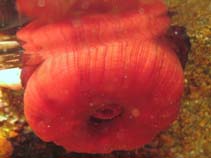
Approximately 6 to 8 cm in height and less than 10 cm in diameter in extension (Ref. 364). Occurs at the water line, especially in sheltered places such as the inside of harbor walls (green Actinia sp.), red Actinia sp. can occasionally be encountered in the intertidal zone of Azores (Ref. 201)); Common run on the rocks, the surface to a few meters of depth (Ref. 364). Also found in infralittoral zones (Ref. 85338). Solitary (Ref. 2377).
Cycle de vie et comportement reproducteur
Maturité | Reproduction | Frai | Œufs | Fécondité | Larves
Members of the class Anthozoa are either gonochoric or hermaphroditic. Mature gametes are shed into the coelenteron and spawned through the mouth. Life cycle: The zygote develops into a planktonic planula larva. Metamorphosis begins with early morphogenesis of tentacles, septa and pharynx before larval settlement on the aboral end.
Wirtz, P., O. Ocaña and T. Molodtsova 2003 Actiniaria and Ceriantharia of the Azores (Cnidaria Anthozoa). Helgoland Marine Research 57:114-117. (Réf. 201)
Statut dans la liste rouge de l'IUCN
(Réf. 130435: Version 2025-2 (Global))
statut CITES (Réf. 108899)
Not Evaluated
Not Evaluated
Menace pour l'homme
Utilisations par l'homme
FAO - Publication: search | FishSource |
Outils
Plus d'informations
Dynamique des populations Cycle de vieReproductionMaturitéFéconditéFraiŒufsDéveloppement de l'œufLarves PhysiologieConsommation d'oxygène
Liées à l'hommeTimbres, pièces de monnaie, divers
Sources Internet
Estimations basées sur des modèles
Vulnérabilité de la pêche
(Réf. 71543) |
Low vulnerability (10 of 100). |
Catégorie de prix
(Réf. 80766): |
Unknown. |