Hexacorallia |
Actiniaria |
Actiniidae
البيئة: الوسط / المنطقة المناخية / نطاق العمق / نطاق التوزيع
البيئة
Sessile; نطاق العمق 3 - 25 m (مرجع 358). Subtropical
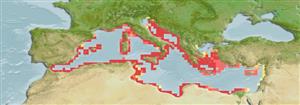
Mediterranean.
الطول عند النضج الأول / الحجم / وزن / العمر
النضج: Lm ? range ? - ? cm
Description: This sea-anemone presents 2 forms, of different aspect and living distinct biotopes, called ecotypes. Ecotype I: 70 to 192 tentacles (in the majority of the cases, this number is included/understood between 142 and 148); Pedal disc of a diameter from 2 to 5 cm. Type II: higher proportions, since it has approximately 192 tentacles and more (even up to 348), with a pedal disc of about 15 cm in diameter. Vertical size, tentacles included/understood: 50 cm. At these 2 ecotypes, the tentacles, with a size of approximately 20 cm, are length higher to the diameter of the oral disc; they are very fine and mobile, but not very contractile. They are laid out in 6 concentric crowns around the siphonoglyphe, and are thinned gradually. Colorings of the 2 types are conditioned by the presence or the absence of symbiotic algae; and are of this fact very fluctuating: white with the tone greens; while passing by the gray and the brown one. Their end frequently raises a bulge of color violet (Ref. 358).
Ecotype I, until depth approximately of 5 m; Ecotype II, 3 up to 25 m (Ref. 358). Dangerous: The ortique one is equipped with a powerful irritant capacity, incompetent however to be exerted through the thick skin of the end of the fingers; prudence however is recommended. In the event of contact, the spirocystes, if they do not cross the skin completely, penetrate it sufficiently to make there adhere the tentacle. Fragile, this one can then be put by inadvertency in contact with more significant parts, such as the face, the neck, the interior of the arms or others, and to prick them. The open wounds of the hands are also significant points. In the event of lesion, to very delicately handle the fragments of tentacles at the time of their elimination, and to relieve the pain by slightly plugging the wounds with alcohol or ammonia a solution diluted. It is also advised to use alleviating pomades to prevent the allergic reactions (Ref. 358). Found hanging on walls that are exposed to the sun's rays or in rocky areas down to a depth of 5 m. It retreats in crevices when currents are strong (Ref. 358). Solitary (Ref. 2377).
دورة الحياة وسلوك التزاوج
النضج | التكاثر | وضع البيض | بيض | الخصوبة | اليرقات
Members of the class Anthozoa are either gonochoric or hermaphroditic. Mature gametes are shed into the coelenteron and spawned through the mouth. Life cycle: The zygote develops into a planktonic planula larva. Metamorphosis begins with early morphogenesis of tentacles, septa and pharynx before larval settlement on the aboral end.
Göthel, H. 1992 Guide de la faune sous-marine: La Méditerranée. Invertébrés marins et poissons. Eygen Ulmer GmbH & Co. 318 p. (مرجع 358)
حالة القائمة الحمراء للاتحاد الدولي لحفظ الطبيعة والموارد الطبيعية
(مرجع 130435: Version 2025-2 (Global))
حالته حسب اتفاقية سايتس (مرجع 108899)
Not Evaluated
Not Evaluated
خطر للأنسان
استخدامات بشرية
FAO - Publication: search | FishSource |
أدوات
مزيد من المعلومات
الديناميكيات السكانيةنمو
الحد الأقصى للأعمار/الأحجام
علاقة الطول بالوزن.
علاقة الطول بالطول.
الطول- الترددات
التحويل الجماعي
الوفرة
دورة الحياةالتكاثرالنضجالخصوبةوضع البيضبيضتطور البيضةاليرقات علم وظائف الأعضاءاستهلاك الأوكسجين
ذات الصلة بالبشرطوابع بريدية وعملات معدنية ومتنوعة
مصادر علي الأنترنت
تقديرات تستند إلى النماذج
ضعف الصيد
(مرجع 71543) |
(0 of 100). |
فئة السعر
(مرجع 80766): |
Unknown. |