Hexacorallia |
Zoantharia |
Parazoanthidae
Umwelt: Milieu / Klimazone / Tiefenbereich / Verbreitungsgebiet
Ökologie
Sessile. Subtropical
Verbreitung
Territories | FAO Gebiete | Ökosysteme | Vorkommen | Einführungen
Atlantic and the Mediterranean: Parazoanthus axinellae adriaticus, Parazoanthus axinellae liguricus, Parazoanthus axinellae muelleri, and Parazoanthus axinellae brevitentacularis are all endemic to the Mediterranean.
Länge bei der ersten Reifung / Größe / Gewicht / Alter
Geschlechtsreife: Lm ? range ? - ? cm Max length : 4.0 cm TL Männchen/unbestimmt; (Ref. 358)
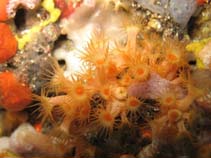
Opened out, the animal, always associated in colonies, measurement up to 4 cm. Individuals: 34 tentacles laid out in double crown. Color: Yellow sharp with orange (Ref. 358).
On abrupt walls; inside underwater excavations and on sponges of the Axinella sp. kind (from where its name) and on various tunicates. Small funds until the greatest depths (Ref. 358). Known from infra- and circalittoral as well as bathyal zones (Ref. 85338).
Lebenszyklus und Paarungsverhalten
Geschlechtsreife | Fortpflanzung | Ablaichen | Eier | Fruchtbarkeit | Larven
Members of the class Anthozoa are either gonochoric or hermaphroditic. Mature gametes are shed into the coelenteron and spawned through the mouth. Life cycle: The zygote develops into a planktonic planula larva. Metamorphosis begins with early morphogenesis of tentacles, septa and pharynx before larval settlement on the aboral end.
Göthel, H. 1992 Guide de la faune sous-marine: La Méditerranée. Invertébrés marins et poissons. Eygen Ulmer GmbH & Co. 318 p. (Ref. 358)
IUCN Rote Liste Status
(Ref. 130435: Version 2025-2 (Global))
CITES Status (Ref. 108899)
Not Evaluated
Not Evaluated
Bedrohung für Menschen
Nutzung durch Menschen
FAO - Publication: search | FishSource |
Tools
Mehr Information
Trophische ÖkologieLebensmittel (Beutetiere)
Nahrungszusammensetzung
Nahrungsaufnahme
Räuber
PopulationsdynamikWachstum
Max. Alter/Größen
Länge-Gewicht-Rel.
Länge-Länge-Verhältnis.
Längenhäufigkeiten
Massenkonvertierung
Dichte
LebenszyklusFortpflanzungGeschlechtsreifeFruchtbarkeitAblaichenEierEientwicklungLarven PhysiologieSauerstoffverbrauch
MenschenbezogenBriefmarken, Münzen, Verschiedenes.
Internet Quellen
Schätzungen auf der Grundlage von Modellen
Anfälligkeit der Fischerei
(Ref. 71543) |
Low vulnerability (10 of 100). |
Preiskategorie
(Ref. 80766): |
Unknown. |