Hydrozoa |
Anthoathecata |
Milleporidae
Environnement : milieu / zone climatique / profondeur / gamme de distribution
Écologie
Benthic; saumâtre; profondeur 0 - 55 m (Réf. 86643). Subtropical
Western Atlantic.
Longueur à la première maturité / Taille / Poids / Âge
Maturité: Lm ? range ? - ? cm
Description synthétique
Morphologie
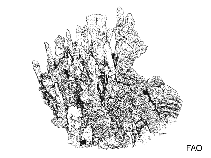
Multiple branches in a single plane with small pores from which the tiny polyps protrude. Tan or mustard with white tips and edges (Ref. 415).
Maximum depth from Ref. 116013. Zooxanthellate (Ref. 121684). In reefs and seagrass beds and occasionally on mangrove roots. Very common in shallow protected areas in Bocas del Torro where there can be solid beds of this species (Ref. 415). Colonial (Ref. 19). Known from tidal inlets, sheltered areas of bays, including mangrove shores, exposed areas of bays, including any ledges at their entrance, sounds, shallow reefs and shallow coastal benthic habitats (< 25 m) (Ref. 86643).
Cycle de vie et comportement reproducteur
Maturité | Reproduction | Frai | Œufs | Fécondité | Larves
Reproduction occurs only in hydroid stage (Ref. 1663, p. 14).
Collin, R., M.C. Díaz, J. Norenburg, R.M. Rocha, J.A. Sánchez, M. Schulze, A. Schwartz and A. Valdés 2005 Photographic identification guide to some common marine invertebrates of Bocas Del Toro, Panama. Caribbean Journal of Science. 41(3):638-707. (Réf. 415)
Statut dans la liste rouge de l'IUCN
(Réf. 130435: Version 2025-2 (Global))
statut CITES (Réf. 108899)
Not Evaluated
Menace pour l'homme
Utilisations par l'homme
FAO - Publication: search | FishSource |
Outils
Plus d'informations
Écologie trophiqueAliments (proies)
Composition du régime alimentaire
Consommation alimentaire
Prédateurs
Dynamique des populationsCroissance
Âges / tailles maximales
Longueur-poids rel.
Rel. longueur-longueur.
Fréquences de longueurs
Conversion de masse
Abondance
Cycle de vieReproductionMaturitéFéconditéFraiŒufsDéveloppement de l'œufLarves PhysiologieConsommation d'oxygène
Liées à l'hommeTimbres, pièces de monnaie, divers
Sources Internet
Estimations basées sur des modèles
Vulnérabilité de la pêche
(Réf. 71543) |
(0 of 100). |
Catégorie de prix
(Réf. 80766): |
Unknown. |