Hydrozoa |
Anthoathecata |
Pandeidae
Umwelt: Milieu / Klimazone / Tiefenbereich / Verbreitungsgebiet
Ökologie
Pelagisch; brackwasser; tiefenbereich 0 - 208 m (Ref. 120471). Polar
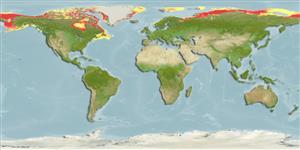
Arctic, Atlantic Ocean and Northeast Pacific: Alaska, Canada and USA. Mostly polar, but also in subtropical and boreal.
Länge bei der ersten Reifung / Größe / Gewicht / Alter
Geschlechtsreife: Lm ? range ? - ? cm Max length : 1.4 cm WD Männchen/unbestimmt; (Ref. 2992)
Bell height measures 12 mm, with a rounded to pointed gelatinous apical projection; large manubrium attached to the radial canals from the top and with a large mouth and horseshoe-shaped folded gonads; 4 smooth-edged radial canals; 8-16 tentacles with laterally compressed bulbs and ocelli; transparent bell but may vary in coloration in the manubrium from reddish to yellowish to brownish (Ref. 2376).
Found in the marine environment and estuaries (Ref. 106119). Meroplanktonic (Ref. 120471). Passively hanging upside down, suspended below the long tentacles (Ref. 2376).
Lebenszyklus und Paarungsverhalten
Geschlechtsreife | Fortpflanzung | Ablaichen | Eier | Fruchtbarkeit | Larven
Species listed only in medusoid stage (Ref. 1663, p. 16).
Cairns, S.D., D.R. Calder, A. Brinckmann-Voss, C.B. Castro, D.G. Fautin, P.R. Pugh, C.E. Mills, W.C. Jaap, M.N. Arai, S.H.D. Haddock and D.M. Opresko 2003 Common and Scientific Names of Aquatic Invertebrates from the United States and Canada: Cnidaria and Ctenophore, Second Edition. American Fisheries Society Special Publication, no,28. XI+115. With CD-ROM. (Ref. 1663)
IUCN Rote Liste Status
(Ref. 130435: Version 2025-2 (Global))
CITES Status (Ref. 108899)
Not Evaluated
Not Evaluated
Bedrohung für Menschen
Nutzung durch Menschen
FAO - Publication: search | FishSource |
Tools
Mehr Information
Trophische ÖkologieLebensmittel (Beutetiere)
Nahrungszusammensetzung
Nahrungsaufnahme
Räuber
LebenszyklusFortpflanzungGeschlechtsreifeFruchtbarkeitAblaichenEierEientwicklungLarven PhysiologieSauerstoffverbrauch
MenschenbezogenBriefmarken, Münzen, Verschiedenes.
Internet Quellen
Schätzungen auf der Grundlage von Modellen
Anfälligkeit der Fischerei
(Ref. 71543) |
Low vulnerability (10 of 100). |
Preiskategorie
(Ref. 80766): |
Unknown. |