Hydrozoa |
Leptothecata |
Sertulariidae
Milieu: milieu / Klimaatzone / Diepte / verspreidingsgebied
Ecologie
Benthic; diepte 6 - 390 m (Ref. 7416). Polar
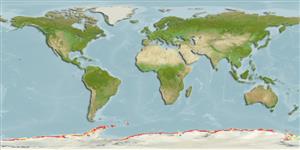
Circum-Antarctic.
Lengte bij maturiteit / Grootte / Gewicht / Leeftijd
Maturiteit: Lm ? range ? - ? cm Max length : 5.0 cm WD mannelijk / geslacht onbekend; (Ref. 7416)
Mass-shaped colonies up to 5 cm diameter, without distinct main stem. Branching irregular, though sometimes with tendency for arrangement in one plane. Branches forming anastomosing stolons. Stem and branches divided into internodes by weakly marked, oblique nodes alternating in opposite directions. One hydrotheca per internode. Hydrothecae almost cylindrical, strongly abcaudally directed. Hydrotheca adnate to internode for approximately half its length, though usually adnate portion longer than free part. Adcauline wall with a distinct inflexion point where it becomes free. Free portion of adcauline hydrothecal wall slightly convex or straight. Abcauline wall concave. Cusps of hydrothecal aperture blunt and separated by shallow embayments. Species with dark coloured coenosarc.
Gonothecae ovoid, inserting at hydrothecal base. Gonothecal wall folded, forming a pattern of seven to ten rings. Gonotheca provided with a distal funnel-shaped neck bearing the gonothecal aperture.
Known at depths of 6 to 385 m on muddy bottoms and shingle, small rocks, gravel, mud, stones and composed of fragments of Bryozoans (Ref. 7416).
Levenscyclus en paargedrag
Maturiteit | Voortplanting | Paaien | Eieren | Fecunditeit | Larven
Found fertile colonies from January to March and July to December; materials collected in January and February.
Peña Cantero, A.L., A. Svoboda and W. Vervoort 2002 Species of Stymplectoscyphus Marktanner-Turneretscher, 1980 (Cnidaria; Hydrozoa: Sertulariidae) from recent Antarctic expeditions with R.V. Polarsten, with the description of four new species. Journal of Natural History 36:1509-1568. (Ref. 7416)
Status op de Rode Lijst van het IUCN
(Ref. 130435: Version 2025-2 (Global))
CITES status (Ref. 108899)
Not Evaluated
Not Evaluated
Gevaar voor de mens
Gebruik door de mens
FAO - Publication: search | FishSource |
Tools
Meer informatie
Trofische ecologieVoedsel (prooien)
Dieetsamenstelling
Voedselconsumptie
Predatoren
PopulatiedynamicaGroei
Max. leeftijden / maten
Lengte-gewicht rel.
Lengte-lengte rel.
Lengtefrequenties
Massaconversie
Abundantie
LevenscyclusVoortplantingMaturiteitFecunditeitPaaienEierenOntwikkeling van de eierenLarven FysiologieZuurstofverbruik
Menselijk gerelateerdPostzegels, munten, diversen.
Internetbronnen
Schattingen op basis van modellen
Kwetsbaarheid van de visserij
(Ref. 71543) |
Low vulnerability (10 of 100). |
Prijsklasse
(Ref. 80766): |
Unknown. |