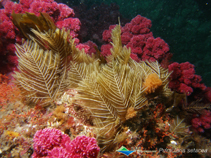
Hydrozoa |
Leptothecata |
Plumulariidae
Milieu: milieu / Klimaatzone / Diepte / verspreidingsgebied
Ecologie
Sessile; diepte 0 - 370 m (Ref. 116013). Temperate
Atlantic, Pacific and Indian Oceans. Temperate and subtropical.
Lengte bij maturiteit / Grootte / Gewicht / Leeftijd
Maturiteit: Lm ? range ? - ? cm Max length : 25.0 cm TL mannelijk / geslacht onbekend; (Ref. 7703)
Known from shallow coastal benthic habitats (< 25m), deeper coastal substrates (25-100m) of the offshore fore-reef slope, Banks and upper slope (> 100m), tops of Challenger and Argus seamounts (Ref. 86643). Also found in Carrie Bow Cay, Belize, in patch reefs, mangrove islands, Thalassia sp. beds, reef crest, low spur and groove zones, sand trough, outer ridge and fore-reef slopes on algae, Thalassia sp. blades, mangrove roots, floating Sargassum sp. and substrates composed of dead corals and gorgonians at depths of 0 to 31m. As with other hydroids, this species exhibits a pelagic medusoid stage (Ref. 87156).
Levenscyclus en paargedrag
Maturiteit | Voortplanting | Paaien | Eieren | Fecunditeit | Larven
Reproduction occurs only in hydroid stage (Ref. 1663, p. 21). Gonochoristic. Sperm swim from the male gonophore to fertilize the eggs held on female gonophores. Fertilized eggs develop into ciliated planula larvae, swim and crawl; metamorphoses into a hydroid (Ref. 1663).
Migotto, A.E., A.C. Marques, A.C. Morandini and F.L. da Silveira 2002 Checklist of the cnidaria medusozoa of Brazil. Biota Neotropica 2(1):1-31. (Ref. 813)
Status op de Rode Lijst van het IUCN
(Ref. 130435: Version 2025-2 (Global))
CITES status (Ref. 108899)
Not Evaluated
Not Evaluated
Gevaar voor de mens
Gebruik door de mens
FAO - Publication: search | FishSource |
Tools
Meer informatie
Trofische ecologieVoedsel (prooien)
Dieetsamenstelling
Voedselconsumptie
Predatoren
FysiologieZuurstofverbruik
Menselijk gerelateerdPostzegels, munten, diversen.
Internetbronnen
Schattingen op basis van modellen
Kwetsbaarheid van de visserij
(Ref. 71543) |
Low vulnerability (13 of 100). |
Prijsklasse
(Ref. 80766): |
Unknown. |