Scyphozoa |
Rhizostomeae |
Lobonematidae
Milieu: milieu / Klimaatzone / Diepte / verspreidingsgebied
Ecologie
Pelagisch. Tropical
Indo-West Pacific.
Lengte bij maturiteit / Grootte / Gewicht / Leeftijd
Maturiteit: Lm ? range ? - ? cm Max length : 50.0 cm WD mannelijk / geslacht onbekend; (Ref. 121705)
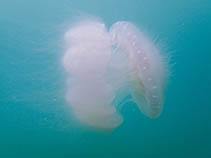
23.6 cm wide, thick, tough and rigid; exumbrella with erect, gelatinous papillae, largest and most abundant at center, about 3.5 to 4 cm long, pointed, with nematocysts; four velar lappets in each octant, 9 to 10 cm long, tapering, pointed; mouth arms 15 cm long, distal three-winged portion one and one-half times as long as proximal portion; numerous long spindle-shaped and thread-like appendages; 16 radial canals.
Levenscyclus en paargedrag
Maturiteit | Voortplanting | Paaien | Eieren | Fecunditeit | Larven
Members of the class Scyphozoa are gonochoric. Life cycle: Egg is laid by the adult medusa which later develops into a free-living planula, then to a scyphistoma to a strobila, and lastly to a free-living young medusa.
Kramp, P.L. 1961 Synopsis of the medusae of the world. J Mar Biol Ass UK 40:1-469. (Ref. 2992)
Status op de Rode Lijst van het IUCN
(Ref. 130435: Version 2025-2 (Global))
CITES status (Ref. 108899)
Not Evaluated
Not Evaluated
Gevaar voor de mens
Gebruik door de mens
FAO - Publication: search | FishSource |
Tools
Meer informatie
Trofische ecologieVoedsel (prooien)
Dieetsamenstelling
Voedselconsumptie
Predatoren
PopulatiedynamicaGroei
Max. leeftijden / maten
Lengte-gewicht rel.
Lengte-lengte rel.
Lengtefrequenties
Massaconversie
Abundantie
LevenscyclusVoortplantingMaturiteitFecunditeitPaaienEierenOntwikkeling van de eierenLarven FysiologieZuurstofverbruik
Menselijk gerelateerdPostzegels, munten, diversen.
Internetbronnen
Schattingen op basis van modellen
Kwetsbaarheid van de visserij
(Ref. 71543) |
Moderate vulnerability (40 of 100). |
Prijsklasse
(Ref. 80766): |
Unknown. |