Hexacorallia |
Scleractinia |
Pocilloporidae
Environnement : milieu / zone climatique / profondeur / gamme de distribution
Écologie
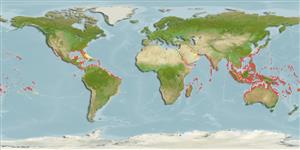
Récifal; profondeur 0 - 26 m (Réf. 269), usually 1 - 15 m (Réf. 98471). Tropical; 36°N - 35°S, 32°E - 10°E (Réf. 847)
Indo-Pacific and Western Central Atlantic: East to Hawaii and Panama, south to Lord Howe Island, west to Red Sea, and north to Japan.
Longueur à la première maturité / Taille / Poids / Âge
Maturité: Lm ? range ? - ? cm Max length : 30.0 cm DL mâle / non sexé; (Réf. 269)
Description synthétique
Morphologie
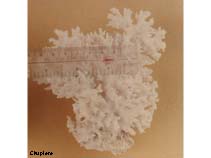
Colonies: Ramose, covered with varrucae; corallites plocoid, less than 1 mm across, found both on varrucae and in between. Tendency of corallites to become cerioid near branch tips. Septa: poorly developed, in 2 cycles, may be reduced to a row to a row of spines. Peritheca: echinulate. Columella: Free. Thickness of branches may vary with exposure to water movement and depth. Colonies growing in shallow water or exposed to wave action: Have thick sturdy branches. Colonies from deep calm waters tend to have thin fragile branches. Color: Mottled brown in life.
Fisheries: Used directly as construction material, to make lime, used to make concrete, and to sell as curios; Live coral collected for aquarium trade; no report of direct consumption as food (Ref. 269). Maximum depth from Ref. 83917. Can be found in shallow waters (Ref. 122680). Forms low, compact colonies; in mono-specific or multi-species reefs throughout its range from shallow depths until 20 m; common, relatively tolerant of sedimentation and low salinity as long as there is adequate water motion (Ref. 269). Also in mangrove swamps and wharf piles (Ref. 98471). Has variable (0-50%) bleaching level and low estimated mortality in Palau (Ref. 66144).
Cycle de vie et comportement reproducteur
Maturité | Reproduction | Frai | Œufs | Fécondité | Larves
Hermaphroditic (Ref. 113712). Reproduce by fragmentation and sexual reproduction (i.e., broadcast spawning) (Ref. 269).
Hodgson, G. 1998 Corals. p. 101-122. In Carpenter, K.E. and V.H. Niem (eds) FAO species identifidication guide for fishery purposes. The living marine resources of the Western Central Pacific. Vol. 1. Seaweeds, coral, bivalves and gastropods. FAO Rome. (Réf. 269)
Statut dans la liste rouge de l'IUCN
(Réf. 130435: Version 2025-2 (Global))
statut CITES (Réf. 108899)
Not Evaluated
Menace pour l'homme
Utilisations par l'homme
Pêcheries: d'intérêt potentiel
FAO - Publication: search | FishSource |
Outils
Plus d'informations
Écologie trophiqueAliments (proies)Composition du régime alimentaireConsommation alimentairePrédateurs Dynamique des populationsCroissanceÂges / tailles maximalesLongueur-poids rel.Rel. longueur-longueur.Fréquences de longueursConversion de masseAbondance PhysiologieConsommation d'oxygène
Liées à l'hommeTimbres, pièces de monnaie, divers
Sources Internet
Estimations basées sur des modèles
Vulnérabilité de la pêche
(Réf. 71543) |
Low vulnerability (20 of 100). |
Catégorie de prix
(Réf. 80766): |
Unknown. |