Hexacorallia |
Scleractinia |
Lobophylliidae
Environnement : milieu / zone climatique / profondeur / gamme de distribution
Écologie
Récifal; profondeur 0 - 40 m (Réf. 848). Tropical; 36°N - 27°S, 32°E - 172°W (Réf. 848)
Indo-West Pacific: East Africa including Red Sea, Indonesia to Melanesia, north to Japan and south to New Caledonia.
Longueur à la première maturité / Taille / Poids / Âge
Maturité: Lm ? range ? - ? cm
Description synthétique
Morphologie
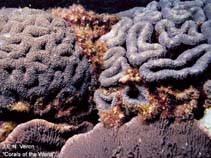
Formation: massive, often hemispherical and over 0.5 m across. Corallites: up to 25 mm diameter and cerioid, becoming plocoid on the colony sides. Septa: mostly uniform, with large teeth. Thick fleshy tissue over the skeleton present. Color: uniformly blue-gray, or mixtures of gray, brown, cream and green; mouth, oral disc and walls usually in contrasting color (Ref. 848).
Occurs in shallow, partly protected reef environments away from high wave action (Refs. 848, 98471) (Ref. 848).
Cycle de vie et comportement reproducteur
Maturité | Reproduction | Frai | Œufs | Fécondité | Larves
Members of the class Anthozoa are either gonochoric or hermaphroditic. Mature gametes are shed into the coelenteron and spawned through the mouth. Life cycle: The zygote develops into a planktonic planula larva. Metamorphosis begins with early morphogenesis of tentacles, septa and pharynx before larval settlement on the aboral end.
Veron, J.E.N. 2000 Corals of the world. Volume 3. Australian Institute of Marine Science and CRR Qld. Pty. Ltd. Australia. 490 p. (Réf. 848)
Statut dans la liste rouge de l'IUCN
(Réf. 130435: Version 2025-2 (Global))
statut CITES (Réf. 108899)
Not Evaluated
Menace pour l'homme
Utilisations par l'homme
FAO - Publication: search | FishSource |
Outils
Plus d'informations
Écologie trophiqueAliments (proies)
Composition du régime alimentaire
Consommation alimentaire
Prédateurs
Dynamique des populationsCroissance
Âges / tailles maximales
Longueur-poids rel.
Rel. longueur-longueur.
Fréquences de longueurs
Conversion de masse
Abondance
Cycle de vieReproductionMaturitéFéconditéFraiŒufsDéveloppement de l'œufLarves PhysiologieConsommation d'oxygène
Liées à l'hommeTimbres, pièces de monnaie, divers
Sources Internet
Estimations basées sur des modèles
Vulnérabilité de la pêche
(Réf. 71543) |
(0 of 100). |
Catégorie de prix
(Réf. 80766): |
Unknown. |