Hexacorallia |
Scleractinia |
Lobophylliidae
Milieu: milieu / Klimaatzone / Diepte / verspreidingsgebied
Ecologie
Rifbewoner; diepte 0 - 30 m (Ref. 848). Tropical; 36°N - 35°S, 103°E - 176°E
Western Pacific: Malaysia to Melanesia, north to Japan and south to New South Wales, Australia.
Lengte bij maturiteit / Grootte / Gewicht / Leeftijd
Maturiteit: Lm ? range ? - ? cm
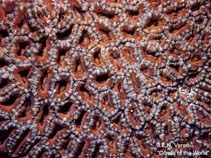
Formation: massive and cerioid, with laterally compressed corallites of uneven height. Acute walls; with thick septa and large teeth. Barely developed columellae. Thick fleshy mantle covered by fine papillae. Color: varies, but commonly red, purple, and green; walls are corallites almost always in contrasting color (Ref. 848).
Occurs in shallow reef environments (Ref. 848), especially in subtropical localities (Ref. 98471).
Levenscyclus en paargedrag
Maturiteit | Voortplanting | Paaien | Eieren | Fecunditeit | Larven
Members of the class Anthozoa are either gonochoric or hermaphroditic. Mature gametes are shed into the coelenteron and spawned through the mouth. Life cycle: The zygote develops into a planktonic planula larva. Metamorphosis begins with early morphogenesis of tentacles, septa and pharynx before larval settlement on the aboral end.
Veron, J.E.N. and G. Hodgson 1989 Annotated checklist of the hermatypic corals of the Philippines. Pacific Science 43:234-287. (Ref. 8817)
Status op de Rode Lijst van het IUCN
(Ref. 130435: Version 2025-2 (Global))
CITES status (Ref. 108899)
Not Evaluated
Gevaar voor de mens
Gebruik door de mens
FAO - Publication: search | FishSource |
Tools
Meer informatie
Trofische ecologieVoedsel (prooien)
Dieetsamenstelling
Voedselconsumptie
Predatoren
PopulatiedynamicaGroei
Max. leeftijden / maten
Lengte-gewicht rel.
Lengte-lengte rel.
Lengtefrequenties
Massaconversie
Abundantie
LevenscyclusVoortplantingMaturiteitFecunditeitPaaienEierenOntwikkeling van de eierenLarven FysiologieZuurstofverbruik
Menselijk gerelateerdPostzegels, munten, diversen.
Internetbronnen
Schattingen op basis van modellen
Kwetsbaarheid van de visserij
(Ref. 71543) |
(0 of 100). |
Prijsklasse
(Ref. 80766): |
Unknown. |